
Centrale photovoltaïque et data center
DC800
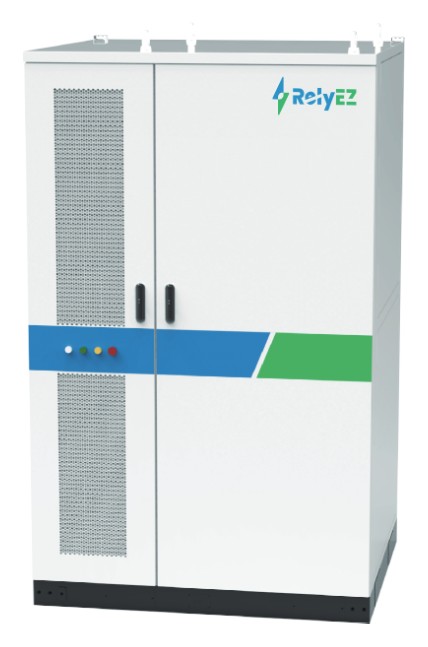
Armoire VentureEdge 800 disponible début 2027
Le stockage qui se greffe sur une centrale ou secourt un data center.
Deux formats pour la même brique. L'armoire VentureEdge 800 — 418 kWh et 209 kW, sortie 800 V, de une à cinq armoires en parallèle — et le conteneur VentureBooster 800, qui réunit cinq de ces grappes pour 1 MW et un peu plus de 2 MWh.
Les deux se raccordent sur le bus 800 V de la centrale, en sortie des onduleurs photovoltaïques. Ils n'ont donc pas besoin de leur propre transformateur : là où une installation classique en aligne deux, un pour le solaire et un pour la batterie, il n'en reste qu'un.
Les mêmes conditions valent pour un data center : une alimentation à protéger, un bus existant sur lequel se greffer, et une puissance à tenir sans coupure. Le DC800 y joue le rôle de réserve et d'écrêtage.
- Centrale photovoltaïque existante à équiper de stockage
- Data center : secours et écrêtage de puissance sur le bus existant
- Site équipé par étapes, une armoire à la fois
- Décalage de l'injection en journée vers les heures chères
- Limitation d'écrêtage sur un raccordement saturé
Configurer
Ajoutez des armoires, lisez la puissance.
Référence
Référence constructeur : YXHK-209K/852314-X
- Énergie
- 836 kWh
- Puissance
- 418 kW
- Ratio
- 2 h
Le ratio, en une ligne : puissance × durée = énergie. Un système 2 heures stocke deux fois sa puissance, un système 4 heures en stocke quatre fois. À énergie égale, un ratio plus long demande moins de puissance de conversion — et vise d'autres revenus.
Schéma de principe
Un transformateur au lieu de deux.
Caractéristiques
Caractéristiques techniques.
Armoire VentureEdge 800
- Énergie nominale
- 418 kWh
- Puissance nominale
- 209 kW
- Tension
- 800 V alternatif
- Courant nominal
- 150,8 A côté alternatif · 157 A côté continu (maximum 179,4 A)
- Plage de tension
- 1 164,8 – 1 497,6 V DC
- Régime de charge / décharge
- 0,5 P
- Surcharge
- 110 % en continu
- Facteur de puissance
- 0,99 / −1 à 1
- Rendement maximal
- 90 % (hors auxiliaires)
- Mise en parallèle
- Jusqu'à 5 armoires, côté alternatif
- Consommation auxiliaire
- 3,2 kW
- Dimensions (L × l × h)
- 1 600 × 1 350 × 2 450 mm
- Indice de protection
- IP 54
- Altitude
- ≤ 2 000 m (3 000 m avec déclassement)
- Température de service
- −30 à 55 °C
- Refroidissement
- Liquide pour les batteries, air pour le PCS
- Extinction incendie
- Aérosol à déclenchement électrique
- Bruit
- ≤ 75 dB à 1 m
- Disponibilité
- Début 2027
Conteneur — côté continu
- Énergie nominale
- 5 × 418 kWh, soit 2 090 kWh
- Configuration
- 5 grappes de 416 cellules en série
- Cellules
- LFP 3,2 V / 314 Ah
- Courant nominal
- 157 A (maximum 179,4 A)
- Plage de tension
- 1 164,8 – 1 497,6 V DC
- Régime de charge / décharge
- 0,5 P
Conteneur — côté alternatif
- Puissance nominale
- 5 × 200 kW, soit 1 MW
- Tension
- 800 V alternatif (−12 % / +10 %)
- Raccordement
- 3 conducteurs + terre
- Courant nominal
- 5 × 145 A
- Fréquence
- 50 / 60 Hz
- Facteur de puissance
- 0,99 / −1 à 1
- Distorsion harmonique
- < 3 % au régime nominal
- Rendement maximal
- 88 % (hors auxiliaires)
Conteneur — installation
- Dimensions (L × l × h)
- 6 058 × 2 438 × 2 896 mm
- Masse
- 25 t
- Indice de protection
- IP 55
- Consommation auxiliaire
- 22 kW
- Température de service
- −30 à 55 °C
- Refroidissement
- Liquide pour les batteries, air pour le PCS
- Extinction incendie
- Aérosol à déclenchement électrique
- Bruit
- ≤ 75 dB à 1 m
- Communication
- RS-485 · Ethernet · CAN, Modbus TCP/RTU
Normes et référentiels
- IEC 62619
- IEC 60730-1
- IEC 63056
- IEC 62477-1
- IEC 61000-6-2/4
- UE 2023/1542
- UN 38.3
- UN 3536
On dimensionne avec vous.
Le raccordement, le contrat, la production déjà en place : trois données suffisent à savoir si cette gamme est la bonne. Sinon, nous vous orientons vers une autre.