
01
Shave the peak
The battery covers power draws above the subscribed capacity. The subscription is sized on the average load, not the peak — and the network bill follows.
Fast charging
France has won the battle of the charging points: more than 200,000 public points, every motorway service area equipped. The 2026 battle is elsewhere — over the power available at the station. That is exactly the problem a battery solves.
200,045
Public charging points at 31 July 2026
13%
Of points exceed 150 kW — the segment that is growing
100%
Of concession motorway service areas equipped with fast charging
12–24 months
Grid-connection lead time for a high-power station
Avere-France / ministry / Gireve barometer, July 2026 · Avere-France, June 2025 · Enedis-RTE, long-distance charging study, July 2021.
The bottleneck
A new-generation station calls for factory-scale power: the first French stations at 1,000 kW per charger can in theory draw more than 8 MW at peak. As early as 2021, Enedis and RTE projected 4 to 12 MW per motorway service area by 2035 — and up to 40 MW on the busiest. The grid can keep up, say the operators — provided it is anticipated: 12 to 24 months for a connection, when chargers go in within weeks.
What changes on 1 January 2026
The tariff rebate that covered up to 75% of the grid-connection cost of publicly accessible stations ended on 31 December 2025. Connection is now paid at full price — every kVA avoided thanks to a battery is worth more than before.
French Mobility Orientation Act, art. 64 · Avere-France, “What changes in 2026”.
The solution
01
The battery covers power draws above the subscribed capacity. The subscription is sized on the average load, not the peak — and the network bill follows.
02
A storage buffer delivers ultra-fast charging on a modest connection: fewer kVA requested, no dedicated substation, and rural or constrained sites that become equippable.
03
The battery charges when the grid has capacity — at night, in off-peak hours — and delivers at peaks. The same asset can, tomorrow, sell that flexibility.
And because a station battery is still a battery, revenues stack as on any storage asset — see how a battery earns its keep.
Those already doing it
France
The operator installs batteries in its stations to bypass grid congestion, and announces solar-equipped stations aiming at 50% self-sufficiency.
Electra announcements, June 2025
France
A rural ultra-fast charging network built on storage: each station relies on a battery unit to offer up to 320 kW on light connections. 100th station in November 2023.
NW / IECharge press releases, 2023
Netherlands
Buffer battery commissioned on the A2 motorway: the operator announces doubled charging capacity without drawing more from the grid.
Fastned announcement, March 2026
United States
At Lost Hills (California), the world's largest Supercharger station runs almost off-grid: 11 MW of solar and 39 MWh of batteries.
Trade press, 2025
Figures and performance as announced by the operators and reported by the press — no independent measurements published.
Our answer
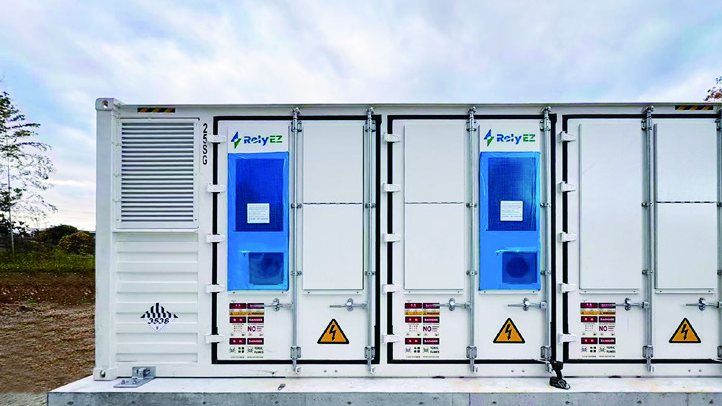
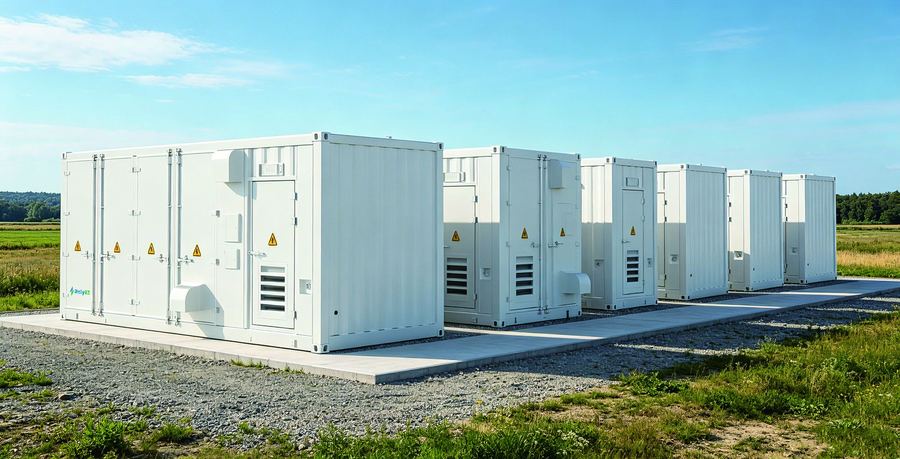
On the hardware side: the industrial and commercial range from RelyEZ — all-in-one VenturePro cabinets, GridUltra containers for hubs — which the manufacturer documents for solar-storage-charging applications, with an EMS that talks to the chargers. Its first solar-storage-charging microgrids have been running since 2019.
On the works side: JR Énergie holds the Qualifelec IRVE qualification, builds solar canopies and already installs chargers — the solar car park with storage and charging, from a single hand. JR Batteries sizes the whole, structures the financing and the revenue.
The rules push the same way
And for your site
Property company, retailer, local authority, operator: we study the power actually needed, what the existing connection allows, and what a battery unlocks — before signing anything with anyone.