
Sizing · Grid connection · 29 September 2026
Commercial battery storage: how to size it
A commercial battery storage system is sized from two quantities, power in kW and energy in kWh, read from the site's load curve and set by the intended use: shaving peaks, keeping solar surplus or shifting consumption. Here is the method, step by step.
By Élien Geneste
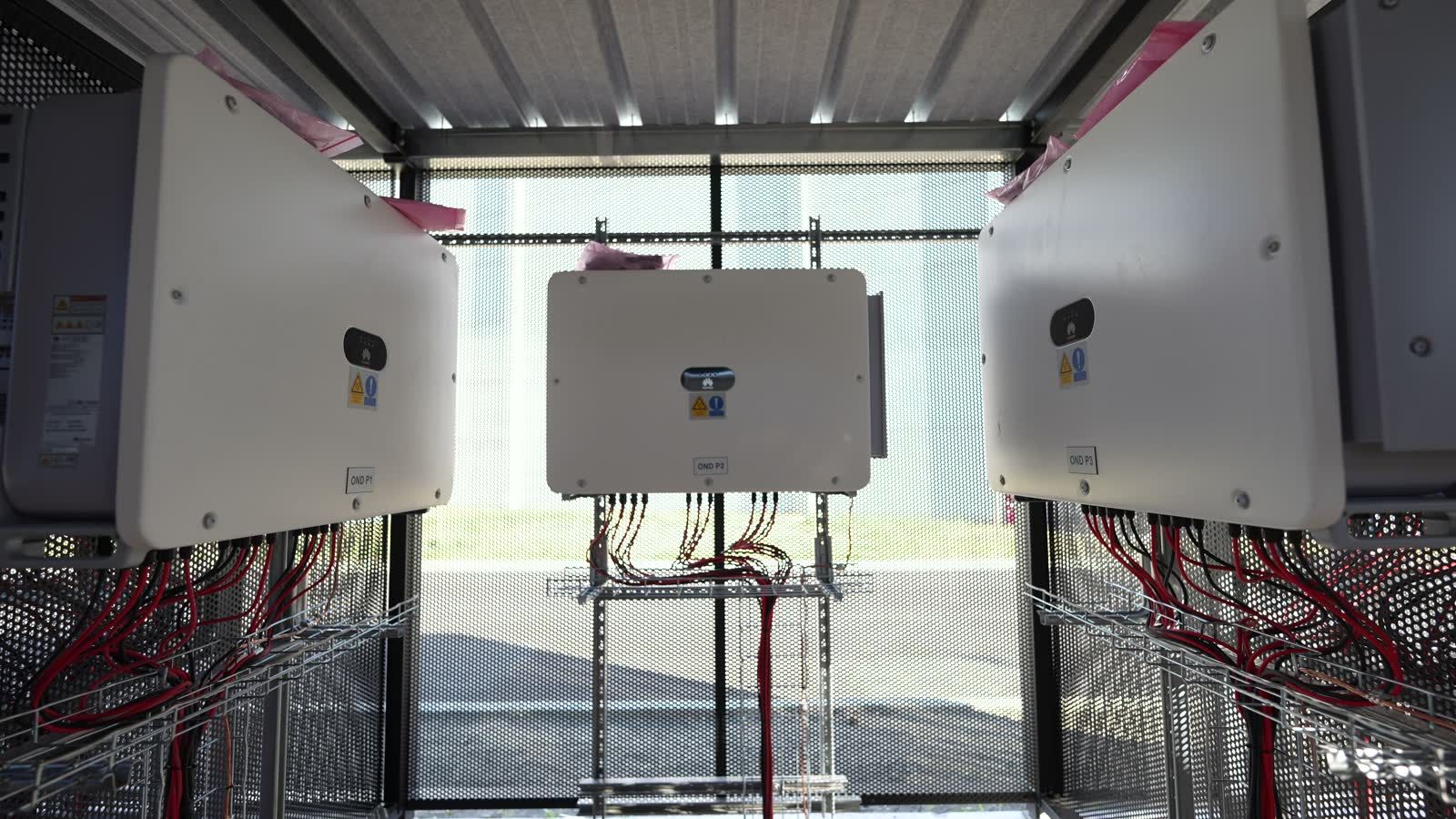
Choosing battery storage for a business starts with two questions: how many
kilowatts must be supplied or absorbed, and for how long? Everything else, from
the number of cabinets to the grid connection, follows from them. This article
sets out the method we use for an industrial, commercial or agricultural site,
from the data to collect through to the choice of range.
What is the battery for?
Sizing starts with the use case, because each one reads the load curve
differently. On a business site, there are four, often combined.
- Shaving power peaks. Above 36 kVA, the network tariff charges for
overruns of the subscribed power, in proportion to their duration for sites
connected at low voltage (TURPE 7 HTA-BT, CRE decision of 13 March 2025). The
battery supplies the peak instead of the grid. - Keeping the surplus from a solar plant. Kilowatt-hours produced at midday
and not consumed are stored for the end of the day instead of being exported. - Shifting consumption. The battery charges when electricity is plentiful
and returns the energy at busy times. RTE counted 513 hours of negative prices
on the French market in 2025, against 352 in 2024, mostly around midday in
spring and summer (Bilan électrique 2025). - Providing grid services. Part of the capacity can be made available
through an aggregator, which markets the power reserve on the
electricity markets.
One system can combine these uses, but they must be ranked: the main use sets
the size, the others use the margin.
Power or energy: which quantities to set?
A battery is described by two figures that must not be confused.
- Power (kW): what the system can supply or absorb at any given moment. It
is sized on the peak to shave or on the largest solar surplus to absorb. - Energy (kWh): the amount stored. It is sized on how long the power must
be sustained.
The ratio of the two gives the discharge time at full power. A
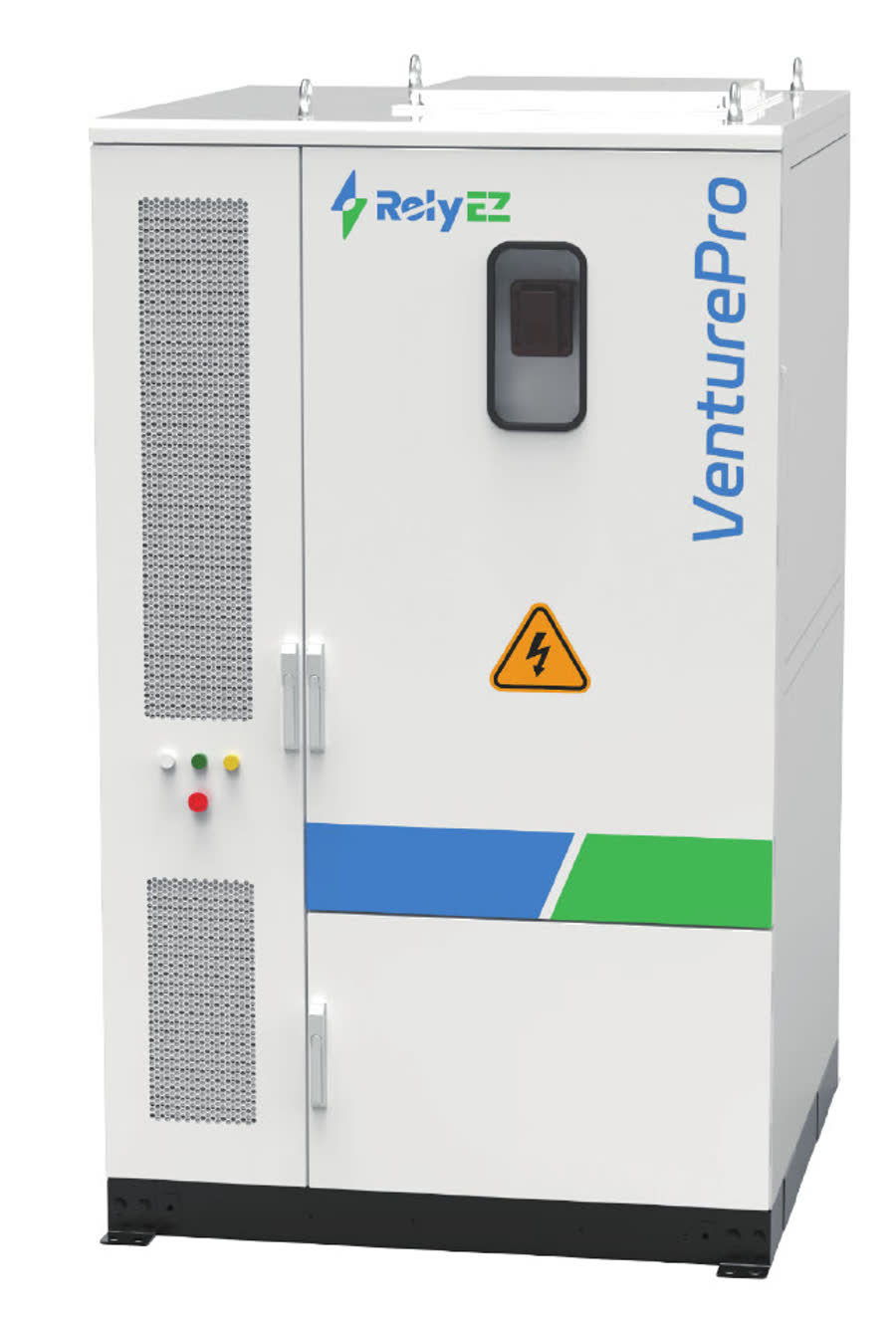
VenturePro 250 cabinet stores 250 kWh and delivers
125 kW: it runs for two hours at full power (RelyEZ VenturePro Series 250 kWh
datasheet). A short peak calls for many kW and few kWh; moving solar surplus
into the evening calls for the opposite.
What data should be gathered before sizing?
Everything starts from measurements, never from an annual average.
- The site's load curve. Enedis gives businesses access to their load
curves, raw and corrected, as well as their consumption peaks and history,
through the business customer portal or by API. - The production curve, if the site has a photovoltaic plant: the inverter
usually records it. - The bills and the contract: subscribed power, overruns charged, tariff
option and off-peak periods. TURPE 7 is gradually moving a large share of
off-peak hours to the afternoon by the end of 2027 (CRE decision
no. 2025-78), which changes a battery's charging windows. - The site's plans: charging points for the fleet, electrification of a
furnace or boiler, a new production line. A battery is sized for tomorrow's
curve as much as for today's.
A full year of measurements is ideal: it shows the busy winter weeks as well as
the summer surpluses.
How do you get from the load curve to the right size?
To shave peaks
First set the threshold the site must no longer exceed. The battery's
power is the gap between the highest peak and that threshold. The
energy is the area of the curve above the threshold, measured over the
longest episode of the year, not over an average peak. If two peaks follow each
other in the same day, check that the battery has time to recharge in between.
To keep solar surplus
Measure, day by day, the energy exported to the grid for lack of consumption.
The temptation is to size on the best day in June: the battery would then be
half empty for the rest of the year. Instead, take a value the site reaches
regularly, looking at how the surpluses are spread season by season, then check
that evening consumption is high enough to empty the battery every day.
Corrections that apply in every case
- Efficiency. You get back less energy than you store. The VenturePro 250
datasheet states a maximum AC efficiency of 90%, excluding the consumption of
auxiliaries (cooling, control). - Usable energy. The system does not go down to zero: size on the energy
actually usable, as stated in the model's datasheet. - Ageing. Capacity declines over the cycles. The VenturePro 250 datasheet
states at least 8,000 cycles; you need an initial margin, or an architecture
that allows cabinets to be added later. - Temperature. Both ranges operate from −30 to 55 °C, with reduced power
outside the −15 / 45 °C range for the VenturePro 250: an exposed location
must be taken into account.
An all-in-one cabinet or a modular system?
Once power and energy are known, the choice of range depends on the grid
connection and on how the site is expected to evolve.
| Venture Pro | Fusion 2 | |
|---|---|---|
| Format | All-in-one cabinet | Control cabinet and battery cabinets |
| Inverter (PCS) | Built in, direct connection at 400 V AC | Provided with the system, supplied by JR Batteries |
| One cabinet | 250 kWh, 125 kW | 261 to 418 kWh depending on the model |
| Expansion | Up to 12 cabinets in parallel | 1 to 8 battery cabinets, up to 3.34 MWh |
| Main target | Industrial or commercial site at low voltage | Photovoltaic or hydroelectric plant |
Sources: RelyEZ VenturePro Series 250 kWh and VenturePro Fusion datasheets.
The Venture Pro range suits a site that wants a complete
system, installed and connected without building a technical room. The
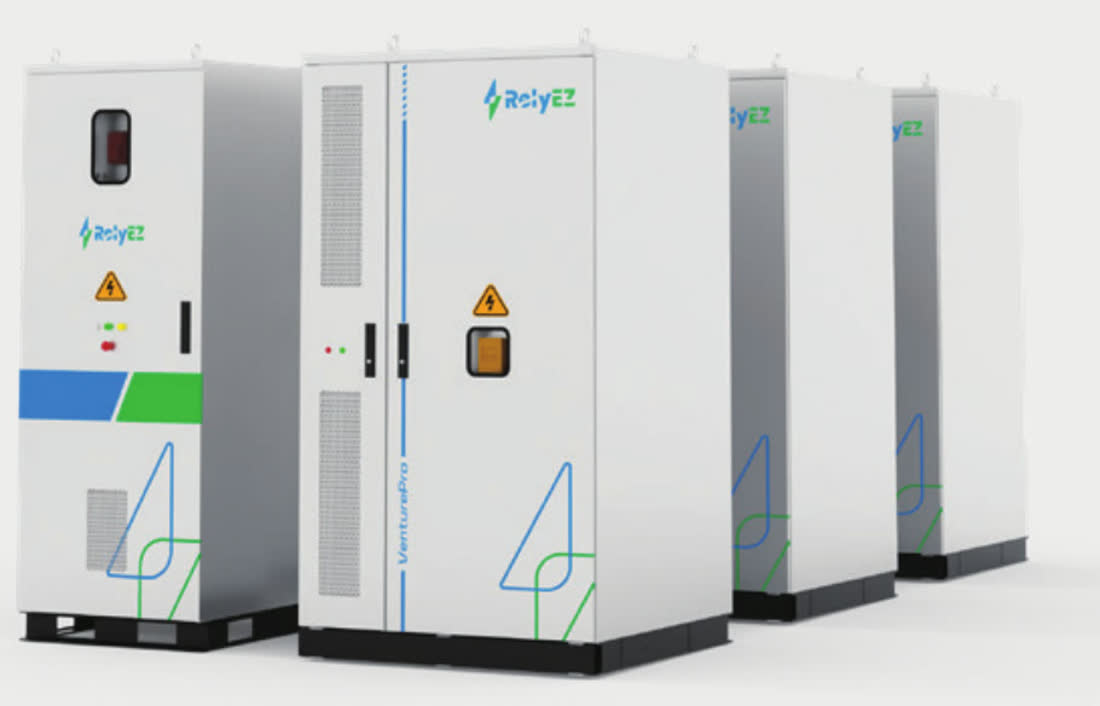
Fusion 2 range suits a need that is set to grow: battery
cabinets are added without changing the architecture. The two ranges cannot
complement each other on the same site, hence the value of choosing from the
start. The catalogue details each model.
What should be checked on site and for the grid connection?
- The location. A VenturePro 250 cabinet has a 1,350 × 1,400 mm footprint
and weighs up to 3,500 kg: the slab, access for the lorry and crane, and
distances to buildings are checked before ordering. - The electrical connection. The main low-voltage switchboard must take the
battery's feeder, and its protection must be coordinated with the site's. - The network operator. A battery that can export energy is treated, for
connection purposes, as a generating installation: the request goes to
Enedis, which sets the conditions. - Standards. The VenturePro 250 datasheet lists, among others, EN 50549-1
on connecting generating plants to the distribution network, and the safety
standards IEC 62619 and UL 9540A.
Where to start?
With the load curve. With a year of measurements, the bills and the site's
plans, several battery sizes are compared for each use case and the one that
works most often is kept. That is what our project assessment
does: it starts from your data and arrives at a detailed configuration, which
you can compare with other offers.
Frequently asked questions
What size of battery storage does a business need?
There is no standard size: it depends on the use case and on the site's load curve. Power (kW) is set by the demand or surplus to absorb, energy (kWh) by how long it must be sustained. A VenturePro 250 cabinet, for example, stores 250 kWh and delivers 125 kW, which means two hours at full power.
What data is needed to size a battery?
The site's load curve, which can be downloaded from the Enedis business customer portal, and, if there is a solar plant, its production curve. Add the bills (subscribed power, overruns, tariff option) and any projects that will change consumption: charging points, electrification of a process, an extension.
Does a battery storage system have to be declared to Enedis?
Yes: a battery connected to a site's internal network must be reported to the network operator, which sets the connection conditions, in particular if it can export. The process goes through the Enedis connection portal. The installer prepares it with the system's technical file.
Can a battery storage system be expanded after installation?
Yes, if the architecture allows for it from the outset. With the Fusion 2 range, one control cabinet manages one to eight battery cabinets, from 261 kWh to 3.34 MWh; with VenturePro, up to twelve cabinets connect in parallel on the same 400 V bus. The two ranges cannot be mixed on the same site.
Does commercial battery storage pay off?
Its value depends on correct sizing: a system matched to the site's real use works every day, an oversized system ties up capital. That is why the assessment starts from the site's load curve and contracts, then compares several sizes before proposing a configuration.
Sources
The figures in this article come from these documents.
- Délibération n° 2025-78 du 13 mars 2025 portant décision sur le tarif d'utilisation des réseaux publics de distribution d'électricité (TURPE 7 HTA-BT) — Commission de régulation de l'énergie (Légifrance), 13 March 2025
- Bilan électrique 2025 — principaux résultats — RTE, 1 February 2026
- J'accède à mes données de consommation et de production d'électricité (professionnels et entreprises) — Enedis, 25 September 2026
- Je raccorde une installation de production d'électricité — Enedis, 25 September 2026
- Fiche technique VenturePro Series 250 kWh — RelyEZ, 27 August 2026
- Fiche technique VenturePro Fusion — Liquid-Cooled Modular Battery Cabinet System — RelyEZ, 27 August 2026
The ranges mentioned
A project in mind?
The grid connection, the contract and the generation already in place are enough to know which range fits.