
Technology · 9 October 2026
LFP or NMC battery: which chemistry for stationary storage
LFP or NMC battery: for fixed storage on a business site, lithium iron phosphate (LFP) chemistry has become the standard. It accounts for 90 % of battery storage systems deployed worldwide, according to the International Energy Agency. NMC keeps the edge on compactness, which matters in a vehicle but rarely decides anything on a site where space can be found.
By Élien Geneste
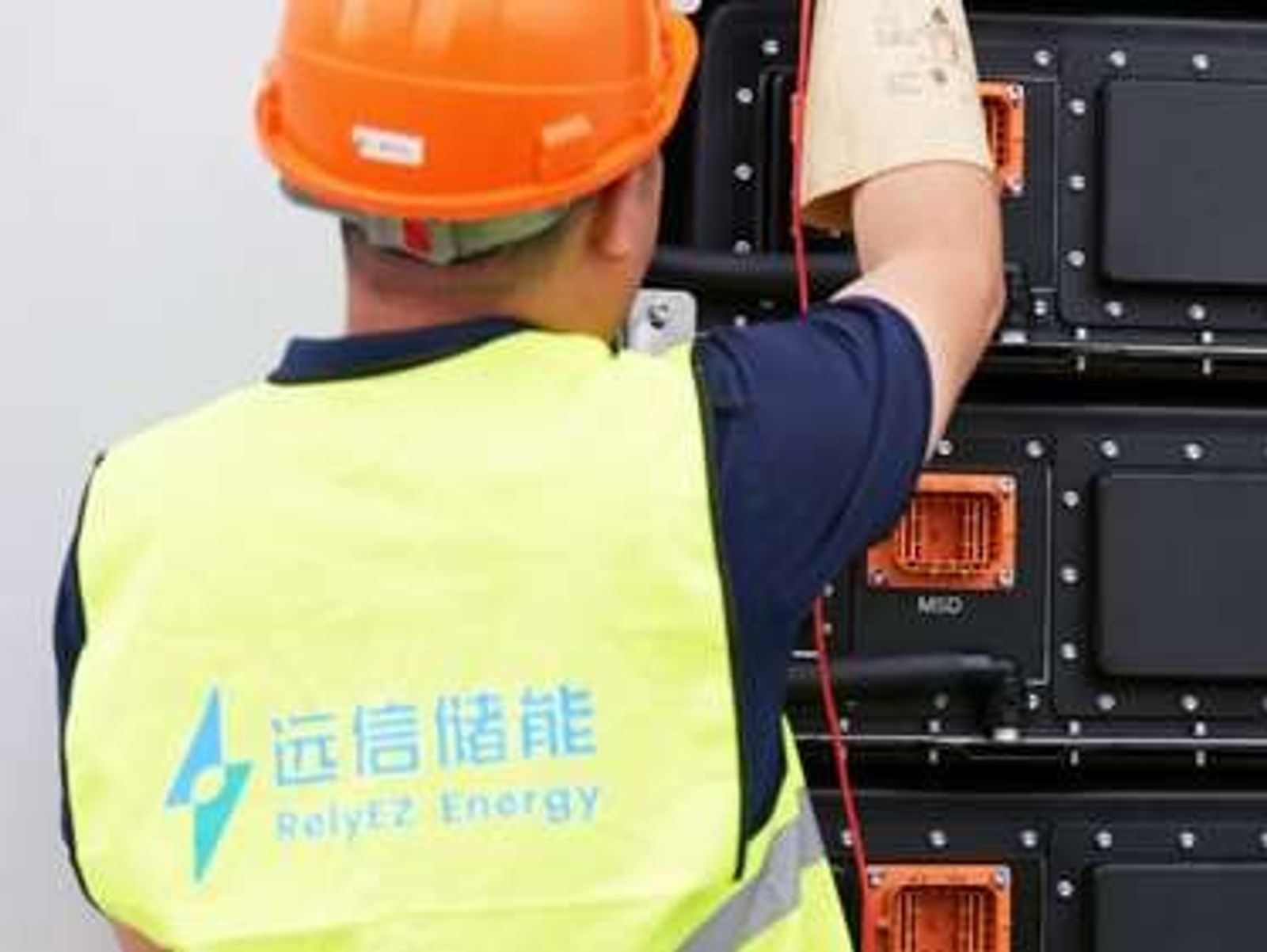
LFP or NMC battery: the question comes up as soon as you compare two storage offers. Both are lithium-ion batteries, and the difference between them lies in the cathode, the part of the cell that takes in lithium ions during discharge. For a fixed system installed on an industrial, commercial or agricultural site, the answer today is fairly clear, and this article explains why, criterion by criterion, with figures from the International Energy Agency (IEA) and from the datasheets of the RelyEZ systems we distribute.
What distinguishes an LFP battery from an NMC battery?
A lithium-ion cell brings together an anode (usually graphite), an electrolyte, a separator and a cathode. The cathode gives the chemistry its name:
- LFP: lithium iron phosphate (LiFePO₄). No nickel, no cobalt.
- NMC: lithium nickel manganese cobalt oxide, in proportions that vary between manufacturers (nickel-rich variants store more).
This choice of material sets three things: how much energy fits into a kilogram of cell, how the cell behaves when it heats up, and what it costs to make. The rest of the system (cell management, converter, control, cooling) is common to both chemistries; our article BESS: the battery energy storage system, part by part covers it in detail.
Which chemistry has the storage market chosen?
IEA figures show a clear underlying trend:
| Value | Source | |
|---|---|---|
| LFP share of new battery storage, 2023 | 80 % | IEA, Batteries and Secure Energy Transitions, 25/04/2024 |
| LFP share of battery storage deployments | 90 % | IEA, Global Energy Review 2026, 20/04/2026 |
| Battery storage installed worldwide in 2025 | 108 GW, 40 % more than in 2024 | IEA, Global Energy Review 2026, 20/04/2026 |
| LFP share of electric vehicle batteries, 2025 | over 55 % | IEA, Global EV Outlook 2026, 20/05/2026 |
In electric cars, both chemistries still coexist. In stationary storage, LFP has become the norm. The IEA sums up the reason in one sentence: LFP batteries are less energy-dense than the chemistries common in vehicles, but typically cheaper and better suited to frequent cycling.
LFP or NMC: how to compare them for a business site?
Here are the criteria that matter for fixed storage, in the order in which they weigh on a project.
| LFP | NMC | What matters on a fixed site | |
|---|---|---|---|
| Energy per kilogram of cell | up to 205 Wh/kg | up to 265 Wh/kg | secondary: space can be found |
| Pack price per kWh (2025) | over 40 % cheaper on average | reference | decisive over the life of the project |
| Cycling performance | better suited to frequent cycling | lower | decisive: a site may cycle every day |
| Behaviour under heat | more stable cathode | needs tighter thermal management | decisive for insurance and permits |
| Raw materials | iron and phosphate | nickel and cobalt | simpler supply |
Densities: latest-generation cells, IEA, Global EV Outlook 2026. Prices: packs, 2025 global average, same source.
Energy density, an advantage that matters mostly in a vehicle
A latest-generation NMC cell stores up to 265 Wh per kilogram, against up to 205 Wh for an LFP cell, according to the IEA. In a car, every kilogram costs range. On a site, a 250 kWh cabinet or a 20-foot container sits on a slab: a few extra square metres rarely weigh against cost and lifespan.
Cycle life, the criterion that creates value
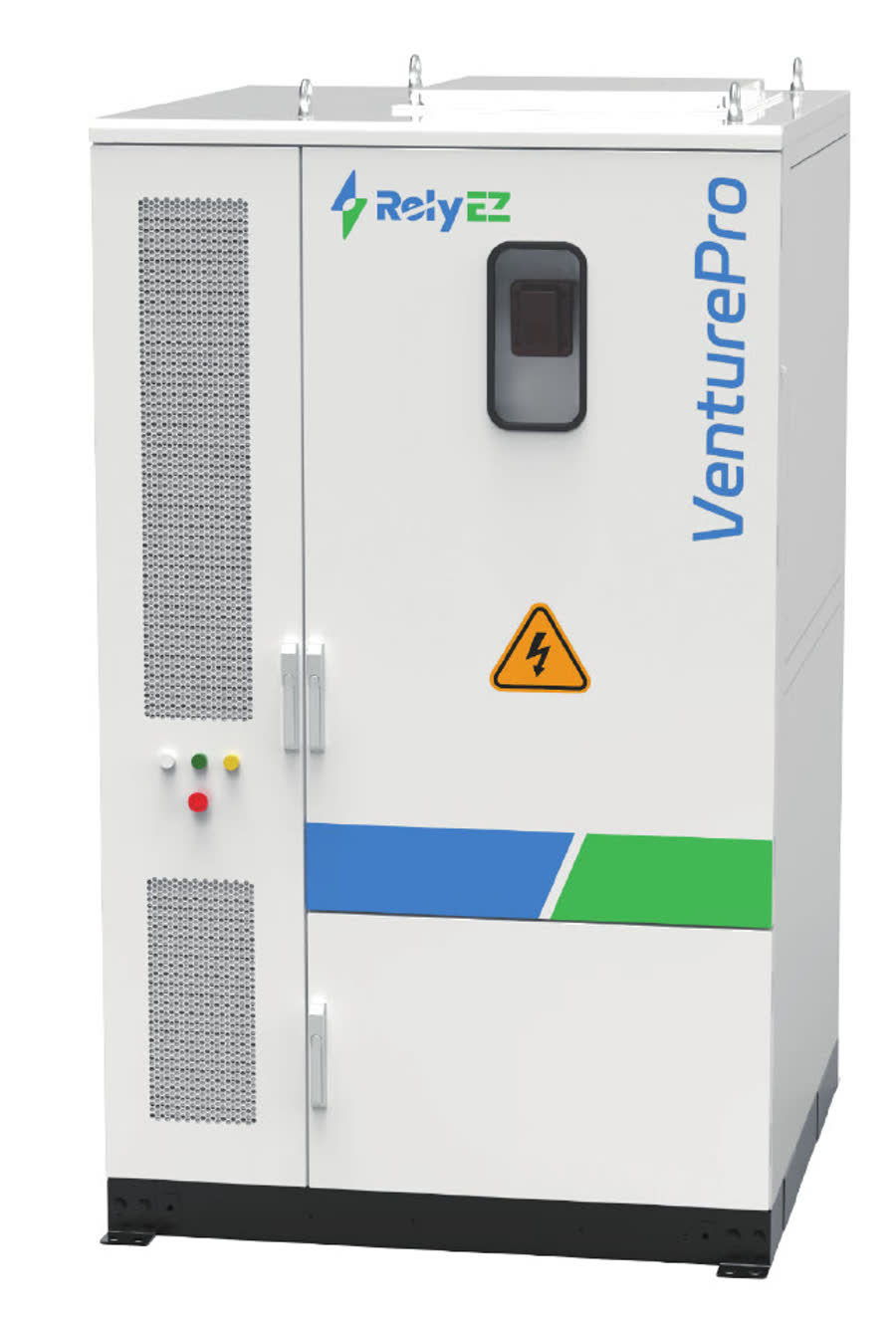
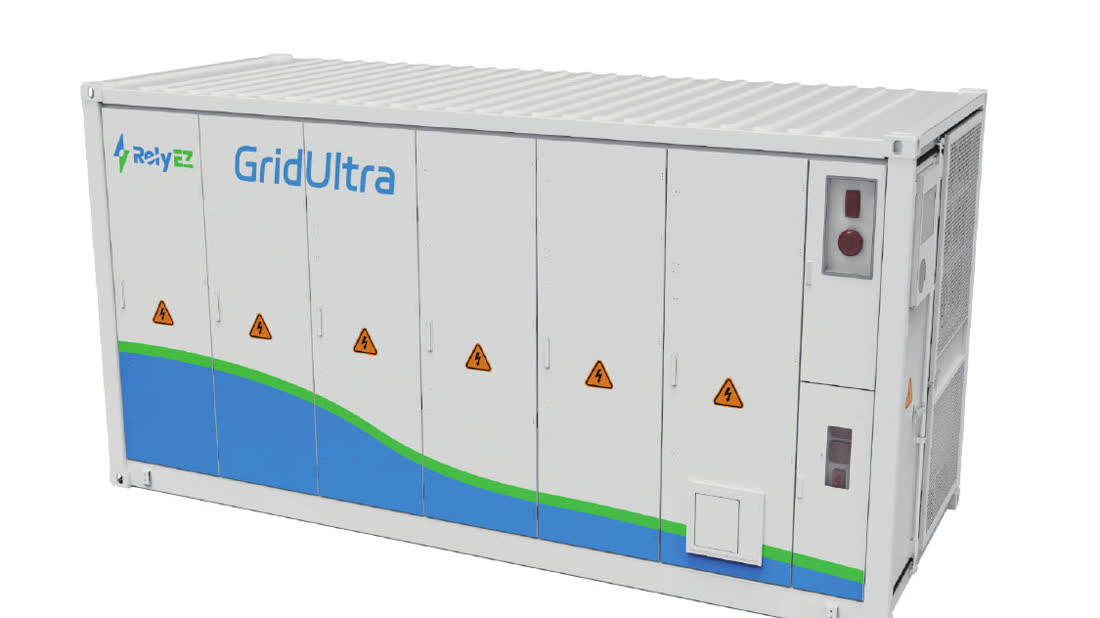
Business storage may charge and discharge once or twice a day: peak shaving, solar surplus, grid services. Over fifteen years, that adds up to thousands of cycles. This is where LFP makes the difference. RelyEZ datasheets state at least 8,000 cycles for the VenturePro 250 cabinet and more than 8,000 cycles, with a 15-year design life, for GridUltra containers.
Actual lifespan depends on use: operating temperature, depth of discharge, number of cycles per year. Hence the value of correct sizing, which avoids working the battery harder than the site really needs (see how to size a storage battery for a business).
Safety, a matter for permits and insurance
The iron phosphate cathode is chemically more stable than nickel and cobalt oxides: it copes better with overheating. That is one of the reasons insurers and inspection bodies look at the chemistry of a storage project first.
Chemistry alone is not enough, though: a system's safety is demonstrated by its tests and standards. The GridUltra range, for example, lists IEC 62619 (safety of lithium cells for industrial use), UL 9540 and UL 9540A (thermal propagation test). These are the documents an inspection body asks for, whatever the chemistry.
Cost, over the life of the project
The IEA notes that in 2025 LFP packs were on average more than 40 % cheaper per kWh than NMC packs. For storage, the right indicator is not the purchase price alone but the cost of each kWh delivered over the whole life of the system: price, number of cycles, efficiency, maintenance. A chemistry that is both cheaper and more durable wins on both counts. The outcome of a project then depends on its sizing and its uses, never on chemistry alone.
When is NMC still a sensible choice?
NMC keeps real strengths where space or weight is the main constraint:
- a cramped plant room where every square metre counts;
- a mobile or on-board installation, where weight has to be carried;
- a project reusing second-life vehicle batteries.
For a cabinet or container standing on open ground, in a car park or on a flat roof, these cases are rare. That is why the professional offer has aligned on LFP.
Which chemistry in RelyEZ systems?
Every RelyEZ range in our catalogue uses the same 3.2 V, 314 Ah prismatic LFP cell. It is assembled into modules, then racks, in the VenturePro 250 cabinet, the modular VenturePro Fusion cabinet and the GridUltra containers.
| Format | Cell | Stated lifespan | |
|---|---|---|---|
| VenturePro 250 | all-in-one cabinet, 250 kWh / 125 kW | prismatic LFP 314 Ah | at least 8,000 cycles |
| GridUltra 4.18 and 5.016 MWh | 20-foot container, liquid cooling | prismatic LFP 314 Ah | more than 8,000 cycles, 15-year design life |
Sources: RelyEZ datasheets, documentation pack of 27/08/2026.
A single cell across the whole range simplifies maintenance and spare parts for a fleet that mixes cabinets and containers. The RelyEZ manufacturer's warranty is 5 years as standard, with an optional extension from 6 to 15 years. The RelyEZ technology page details the assembly, from cell to container.
How to decide for your project?
Three questions are usually enough:
- How many cycles per year? The more the site cycles, the more LFP's endurance counts.
- How much space is available? If a slab or a parking space is free, NMC's density brings nothing decisive.
- What do the insurer and the inspection body require? Cell and system standards, propagation tests, siting distances: check them at the preliminary design stage.
For a business storage battery, LFP is the default answer. The real work then lies in sizing: power, energy, grid connection and the site's uses. That is what we study with you during the assessment.
Frequently asked questions
What is the difference between an LFP battery and an NMC battery?
Both are lithium-ion batteries; they differ by their cathode. LFP uses lithium iron phosphate, NMC a nickel, manganese and cobalt oxide. NMC stores more energy per kilogram, while LFP costs less and copes better with repeated cycling, according to the International Energy Agency.
Why does LFP dominate stationary storage?
Because its strengths match the use: a fixed site cycles often, has room and looks for the best cost per kWh over time. The IEA reports that LFP accounts for 90 % of battery storage deployments, against 80 % of new installations in 2023.
Is there still a place for NMC batteries on a business site?
It can make sense where floor space or weight are tightly constrained, for example in a cramped plant room or a mobile installation. For a cabinet or container standing on open ground or in a car park, compactness rarely brings enough to offset a higher price and weaker cycling performance.
How many cycles does an LFP storage battery last?
It depends on the model and on operating conditions. RelyEZ datasheets state at least 8,000 cycles for the VenturePro 250 cabinet and more than 8,000 cycles, with a 15-year design life, for GridUltra containers. Temperature, depth of discharge and the number of cycles per year determine the actual lifespan.
Which chemistry do the RelyEZ systems distributed by JR Batteries use?
Every RelyEZ range in the catalogue uses the same 3.2 V, 314 Ah prismatic LFP cell. It is found in the VenturePro 250 cabinet, the VenturePro Fusion and the GridUltra containers, which simplifies maintenance across a mixed fleet.
Sources
The figures in this article come from these documents.
- Global Energy Review 2026 — Battery storage — Agence internationale de l'énergie (AIE), 20 April 2026
- Global EV Outlook 2026 — Electric vehicle batteries — Agence internationale de l'énergie (AIE), 20 May 2026
- Batteries and Secure Energy Transitions — Agence internationale de l'énergie (AIE), 25 April 2024
- Fiche technique VenturePro Series 250 kWh — All-in-one Liquid-Cooled Energy Storage — RelyEZ, 27 August 2026
- Fiche technique gamme GridUltra 4,18 MWh (0.25P) et 5,016 MWh (0.5P) — stockage conteneurisé à refroidissement liquide — RelyEZ, 27 August 2026
The ranges mentioned
A project in mind?
The grid connection, the contract and the generation already in place are enough to know which range fits.