
Revenue and markets · Sizing · 30 September 2026
Negative electricity prices: what a battery changes for a solar PV plant
Negative prices hit solar PV exactly when it produces the most: in the middle of the day, in spring and summer. A battery installed at the plant stores those kilowatt-hours instead of exporting or curtailing them, and releases them in the evening, when prices rise again. Here is how the phenomenon is evolving, who it affects and how to size the storage.
By Élien Geneste
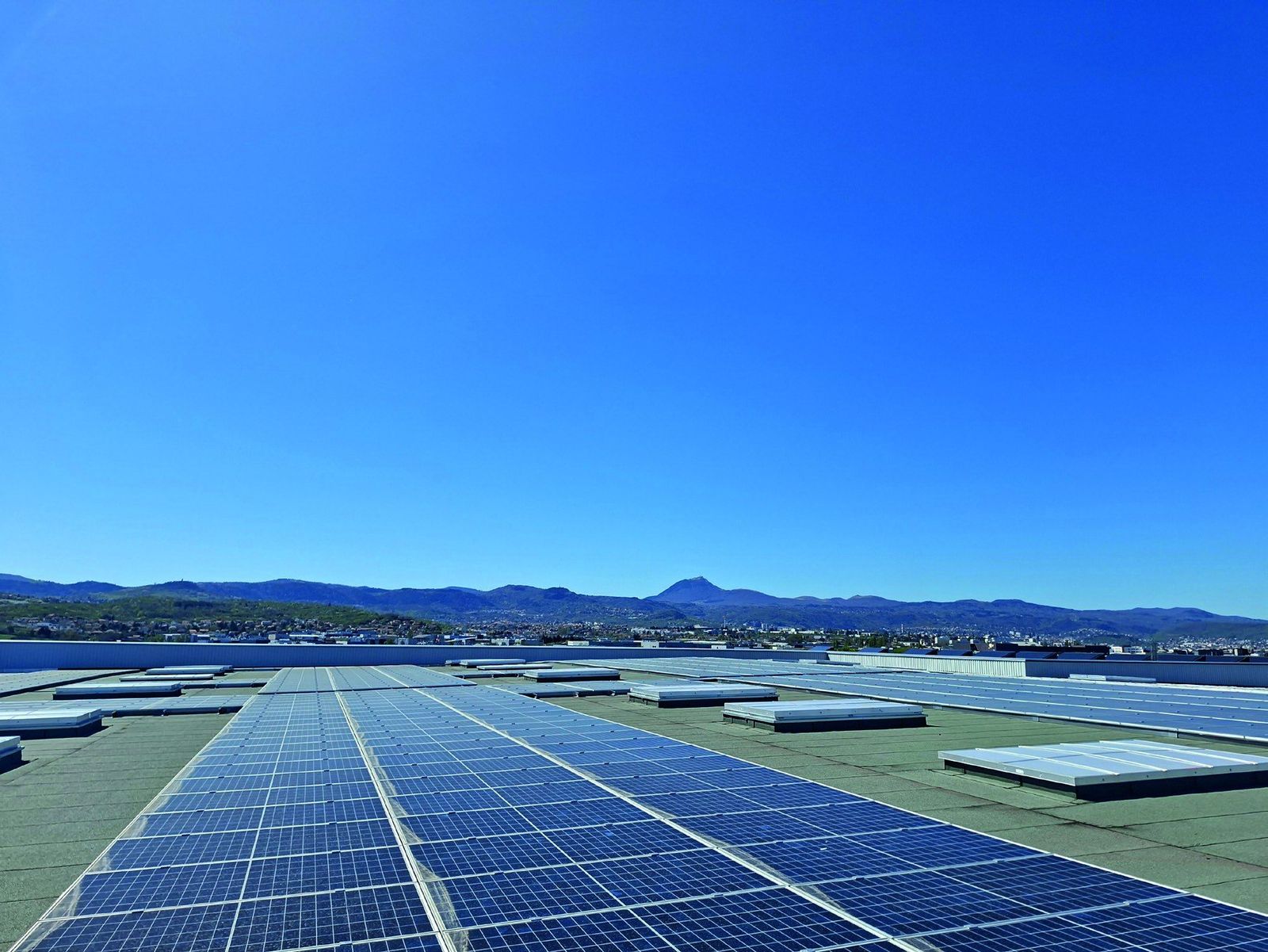
Negative prices have become an operating fact for every solar PV plant in France: in 2025, RTE counted 513 hours during which the electricity spot price fell below zero, and the first half of 2026 has already totalled 407. These hours fall when the sun shines the most. This article explains why, who is affected depending on their contract, and what a battery concretely changes for a producer, from the principle to the sizing.
What is a negative electricity price?
A negative price appears on the spot market when supply exceeds demand and some producers prefer to pay to export rather than modulate their output. For the buyer, electricity is then worth less than zero during the hour in question.
In its 2025 electricity review, RTE describes a "distortion" of the hourly price curve: the morning and evening peaks are now higher, while the midday plateau has turned into a trough, driven by lower consumption and the growth of solar in France and in Europe. That same year, the solar fleet grew by 5.9 GW, reaching 30.4 GW installed.
| 2024 | 2025 | |
|---|---|---|
| Hours with a negative spot price | 352 h | 513 h |
| Hours at 100 €/MWh or more | 1,382 h | 1,807 h |
| Average annual spot price | 58 €/MWh | 61 €/MWh |
The table shows both sides of the same phenomenon: more hours below zero, but also more expensive hours. It is this spread, a few hours apart on the same day, that gives storage its value.
Will negative prices last?
The 2026 figures point the same way. According to the first-half review published by RTE on 16 July 2026:
- 407 hours of negative prices between January and June 2026, or 10 % of the time, against 363 hours in the first half of 2025;
- record lows reached on 26 April (−478.8 €/MWh) and 1 May (−498.7 €/MWh);
- an average price during negative episodes of −16.2 €/MWh, against −7.8 €/MWh a year earlier.
The vast majority of episodes remain close to zero: 64 % of the negative hours in the first half of 2026 were between −1 €/MWh and zero. But the share of prices below −50 €/MWh doubled, from 4 % to 8 % of occurrences. RTE expected negative-price episodes to remain frequent until the end of summer 2026.
For a producer, the question is therefore no longer whether these hours will come back, but how to organise the plant so that they weigh as little as possible on its output.
Who is affected by negative prices in solar PV?
The effect depends on the contract under which the plant sells its electricity.
- Sale at market price or a spot-indexed contract. The producer receives the hourly price directly: negative hours show up on its sales invoice.
- Contract for difference (complément de rémunération). RTE states that this mechanism, which covers the largest solar PV installations commissioned in 2025, provides an economic incentive to modulate output when market prices are negative. The plant then has an interest in lowering its output during those hours.
- Feed-in tariff (obligation d'achat). Article 175 of the 2025 Finance Act allows the obligated buyers to request that the largest installations stop during negative prices, with compensation for the output not produced. In its opinion of 5 December 2025, the CRE describes a draft order covering solar plants above 12 MWp and recommends lowering that threshold to 10 MWp.
- Self-consumption with surplus sale. The midday surplus goes onto the grid when it is worth the least, while the site buys its electricity back in the evening.
In every case, midday output loses value, whether it is sold cheaply, modulated or stopped. RTE puts the solar output modulated during negative-price episodes in 2025 at 1.6 TWh; for solar and wind combined, that volume doubled in one year.
What does a battery do during negative-price hours?
A battery connected to the plant changes where the midday kilowatt-hours go. Instead of being exported at a negative price or not produced at all, they are stored, then released a few hours later, during the evening peak.
The principle works in three steps:
- Charge during the trough. When the price falls below zero or close to it, the control system directs output to the battery.
- Hold the charge for a few hours. The energy waits for prices to rise in the late afternoon.
- Release at the peak. The battery exports when the price is highest, or supplies the site if it is consuming.
The gain is not measured in negative hours. It depends on the spread between the charging price and the discharging price, minus conversion losses: the VentureEdge 800 cabinet, for example, shows a maximum efficiency of 90 % excluding auxiliaries on its datasheet. That is why we never promise a result before studying the plant's data.
The same battery can also be put to work outside negative hours: grid services, participation in the capacity mechanism, shifting output on ordinary days. These revenues go through an aggregator, which bids the capacity on the markets and sends the charge and discharge instructions.
How do you size a battery for a solar PV plant?
Two quantities are enough to describe the battery: its power, in kW, and its energy, in kWh. For a plant exposed to negative prices, they are read from three data sets.
- The plant's hourly production curve, ideally over a full year, to know the power exported during the trough hours.
- Historical hourly spot prices, to identify the typical length of negative episodes and the time at which prices rise again.
- The sales contract and the grid connection, which set what the plant can export, when, and at what price.
Power is set by the share of midday output to be shifted; energy, by how long it must be absorbed. A battery that is too small leaves output sold cheaply; one that is too large ties up capital that only works a few days a year. The right size lies between the two, found by comparing several sizes on the same data.
Which range for which plant?
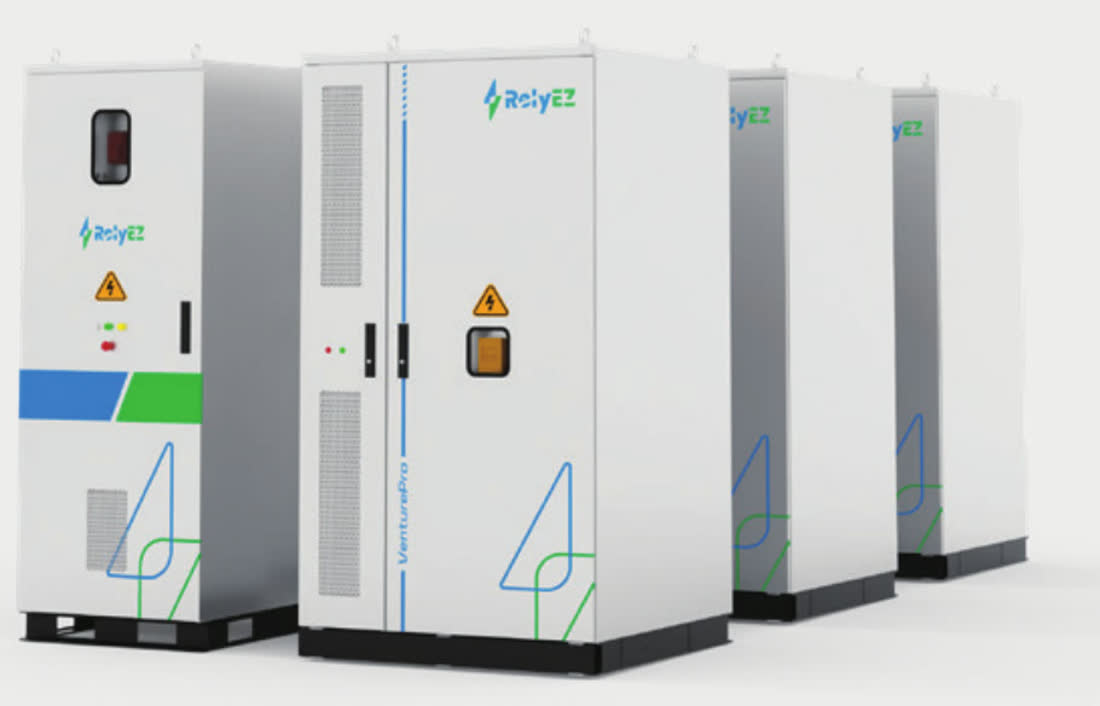
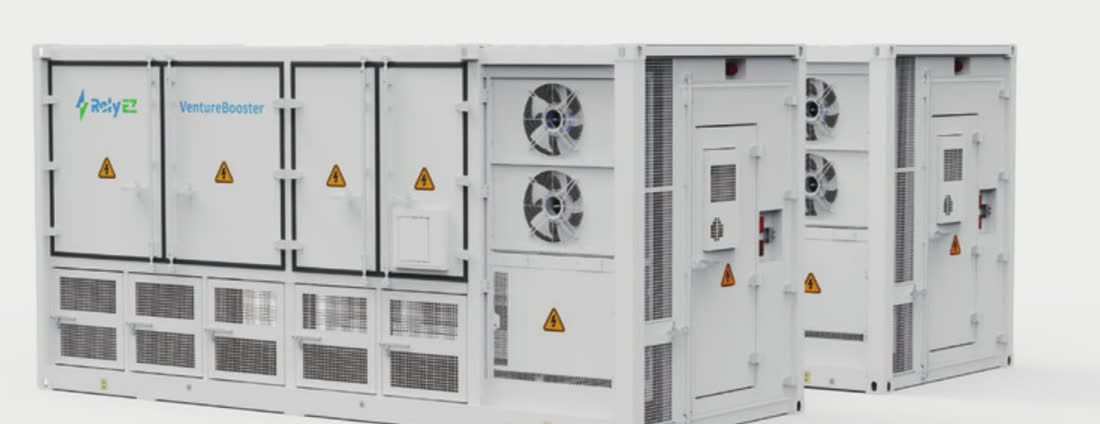
| DC800: VentureEdge 800 | DC800: VentureBooster 800 | Fusion 2 | |
|---|---|---|---|
| Format | Cabinet | Container | Modular cabinets |
| Energy | 418 kWh per cabinet | 2,090 kWh | 261 kWh to 3.34 MWh |
| Power | 209 kW per cabinet | 1 MW | 130.6 to 208.9 kW per cabinet |
| Connection | The plant's 800 V bus | The plant's 800 V bus | Converter supplied with the project |
| Extension | Up to 5 cabinets in parallel | One container | 1 to 8 battery cabinets |
The DC800 range connects to the plant's 800 V bus, at the output of the solar inverters. It needs no transformer of its own: where a conventional installation lines up two, one for the solar and one for the battery, only one remains. Its 0.5 P rating corresponds to two hours of discharge at full power. The VentureEdge 800 cabinet will be available in early 2027.
The Fusion 2 range suits plants with a different architecture: one control cabinet manages one to eight battery cabinets, and more cabinets are added if the need grows. The converter is not integrated; we size and supply it with each project.
Where do you start?
The starting point is a diagnostic of the plant: production curve, contract, grid connection and available space. We then compare several battery sizes against real hourly prices, and propose a configuration and a connection scheme. Installation, the grid connection file and maintenance are handled by our installation partner JR Énergie.
Negative prices do not make the value of a solar plant disappear: they move it a few hours within the day. A well-sized battery lets the plant follow that shift.
Frequently asked questions
How many hours of negative prices are there in France?
RTE counted 513 hours of negative spot prices in 2025, against 352 in 2024. In the first half of 2026, the count had already reached 407 hours, or 10 % of the time, against 363 hours in the first half of 2025. They occur mainly in the middle of the day, when solar output is abundant and demand is low.
Why do negative prices hit solar PV first?
Because they occur precisely when the panels produce the most: from late morning to mid-afternoon, in spring and summer. RTE describes a midday plateau that has turned into a trough, while the morning and evening peaks are higher. A plant without storage sells its output at the worst time of day.
Does a battery make money in every negative-price hour?
No: the number of hours does not make a margin. What counts is the spread between the price at which the battery charges and the price at which it discharges, minus conversion losses. That is why sizing starts from the site's production curves and hourly prices, not from an annual count.
Can a battery be added to an existing solar PV plant?
Yes. The DC800 range is designed to connect to the plant's 800 V bus, at the output of the inverters, with no transformer dedicated to the battery. For a plant with a different architecture, the Fusion 2 range is paired with a converter that we size and supply with the project.
Who sells the stored electricity on the markets?
An aggregator. It bids the battery's capacity on the electricity markets and sends the charge and discharge instructions. The control system decides hour by hour between storing, releasing and providing grid services, according to the plant's contract.
Sources
The figures in this article come from these documents.
- Bilan électrique 2025 — principaux résultats — RTE, 1 February 2026
- Bilan du premier semestre 2026 et perspectives sur la sécurité d'approvisionnement en électricité pour les prochains mois — RTE, 16 July 2026
- Prix négatifs : la CRE publie son avis sur un projet d'arrêté d'application de la loi de finances — Commission de régulation de l'énergie, 5 December 2025
- Fiche technique VentureBooster 800 — RelyEZ, 27 August 2026
- Fiche technique VentureEdge 800 (anglais) — RelyEZ, 9 September 2026
- Fiche technique VenturePro Fusion — Liquid-Cooled Modular Battery Cabinet System — RelyEZ, 27 August 2026
The ranges mentioned
A project in mind?
The grid connection, the contract and the generation already in place are enough to know which range fits.