
Technology · Grid connection · 20 October 2026
Battery storage container: what it contains, how it is installed
A battery storage container is a 20-foot shipping container that arrives on site assembled and tested: battery racks, cooling, fire protection and power distribution are fitted at the factory. On site, the foundation is prepared, the container is set down and connected to the converter and the grid. Here is what is inside, and the steps to install it.
By Élien Geneste
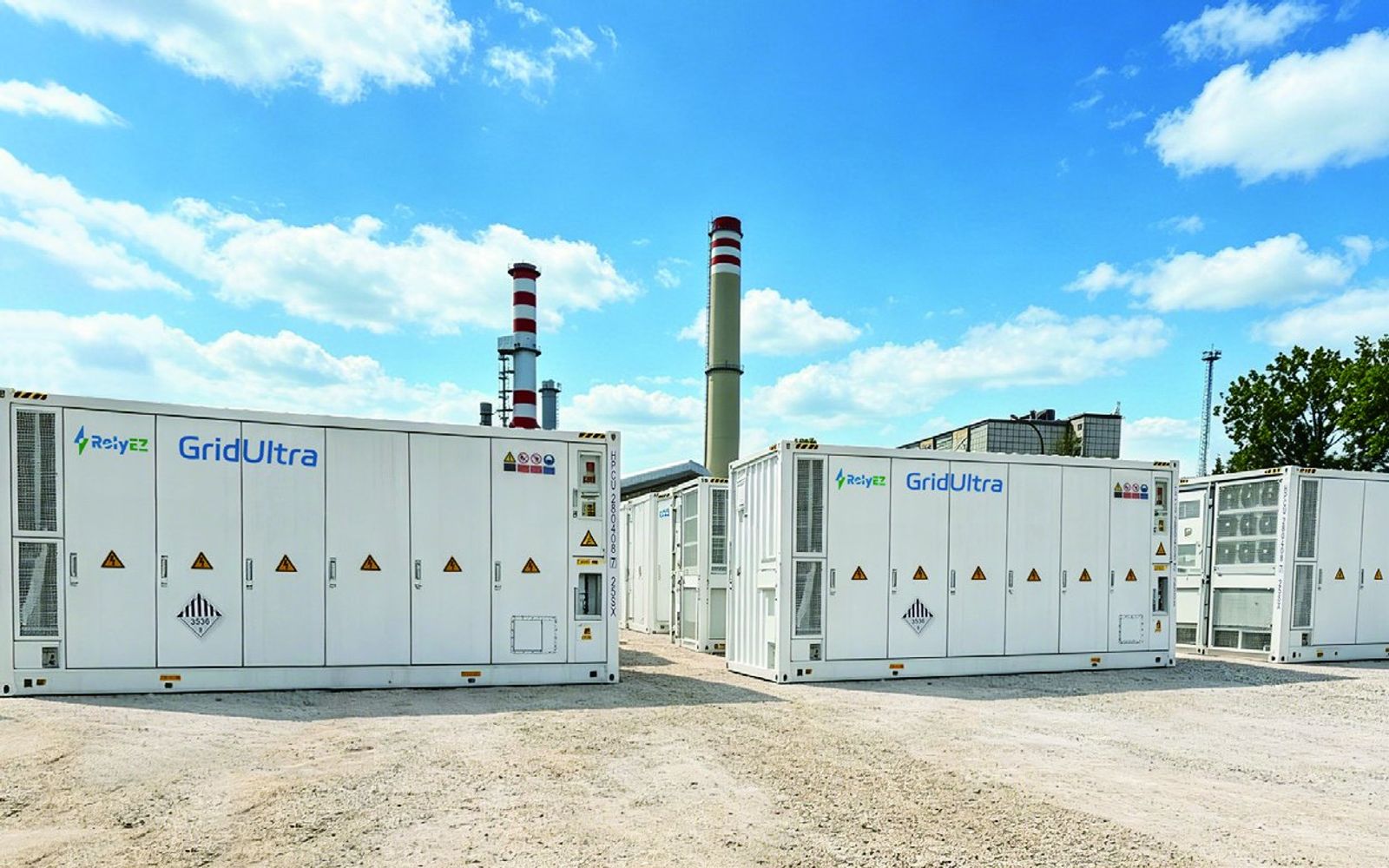
A battery storage container is the form electricity storage takes once you go beyond a few hundred kilowatt-hours: a shipping container, delivered closed, holding everything needed to store and return several megawatt-hours. This article describes what is inside, based on the datasheets of the RelyEZ GridUltra range, then the steps to install one on a site in France.
What is a battery storage container?
It is a battery energy storage system (BESS) built into a standard 20-foot shipping container. The French Energy Code defines storage as deferring the use of electricity to a time after it was produced (Article L. 352-1, recalled by the CRE in its deliberation No. 2022-105): the container is the format of this storage at the scale of power plants and the grid.
The format has three advantages. It travels like any other container, by truck, train or ship. It arrives assembled and tested at the factory, which reduces work on site. And it scales: two, ten or fifty identical containers are lined up depending on the size of the project.
In France, the Renewable Electricity Overview published on 16 July 2026 by SER, RTE, Enedis and Agence ORE counts 1,617 MW of battery storage connected at the end of 2025, of which 410 MW was commissioned during the year.
What does a battery container contain, piece by piece?
From the inside out:
- The cells: in the GridUltra range, 314 Ah prismatic lithium iron phosphate (LFP) cells. The same cell is used across every RelyEZ range in the catalogue.
- The modules: 52 cells in series in a liquid-cooled, IP 67 sealed housing, on the 4.18 and 5.016 MWh versions.
- The racks: eight modules and one high-voltage control box each. The 4.18 MWh container has 10 of them, the 5.016 MWh container has 12.
- The battery management system (BMS): it measures voltage, current and temperature module by module and controls the protections.
- The cooling: a liquid circuit or air-conditioned ventilation, depending on the model.
- The fire protection: a stand-alone system, with multi-point monitoring and alarms.
- The power distribution: the cabinet that combines the racks into a single DC output, and the auxiliary power supply.
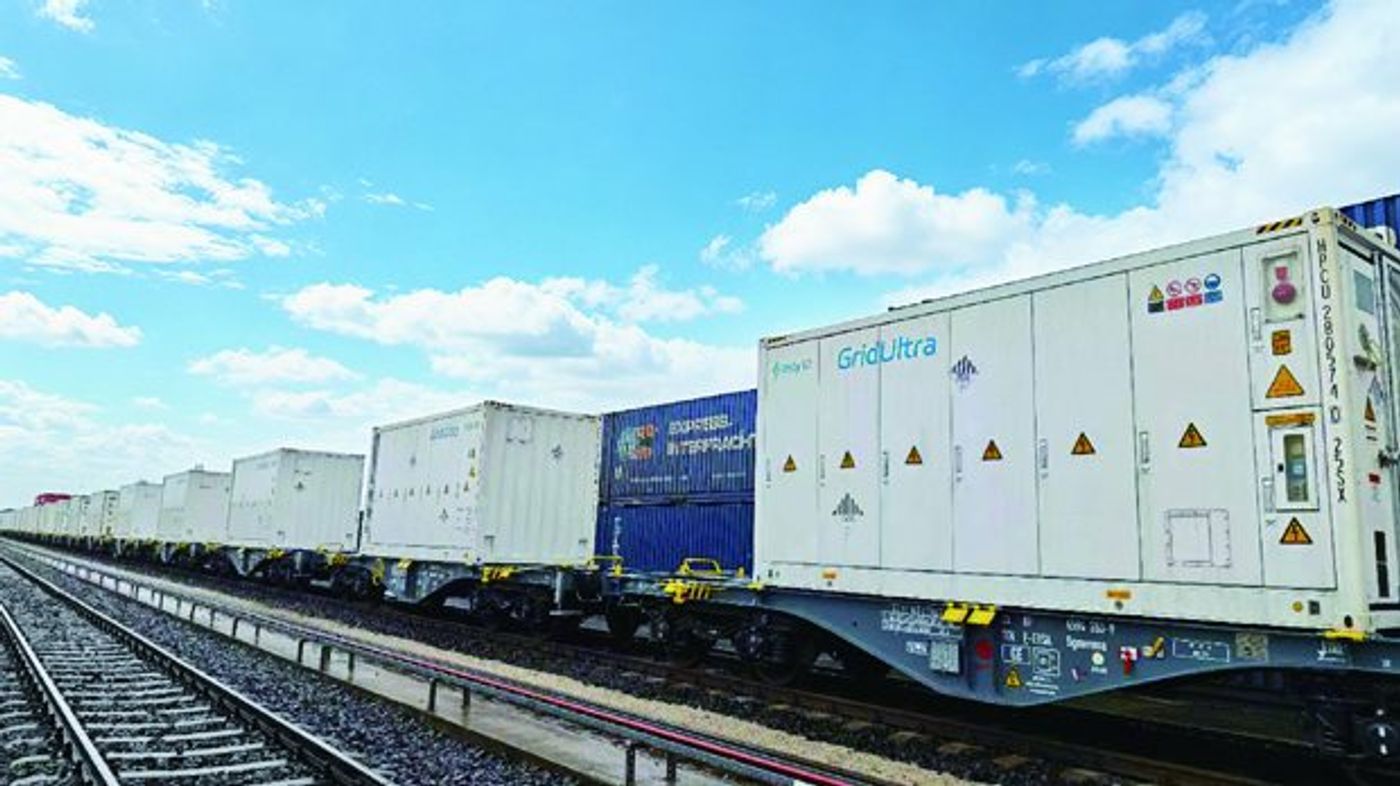
What is not always inside: the converter (PCS, Power Conversion System), which turns the batteries' direct current into alternating current for the site or the grid. The GridUltra 2058 integrates it, with a transformer, and delivers 400 V AC. The GridUltra 4.18 and 5.016 MWh are DC battery containers, at 1,331.2 V nominal: the converter and the transformer substation are installed alongside and chosen with them.
How much energy and power per container?
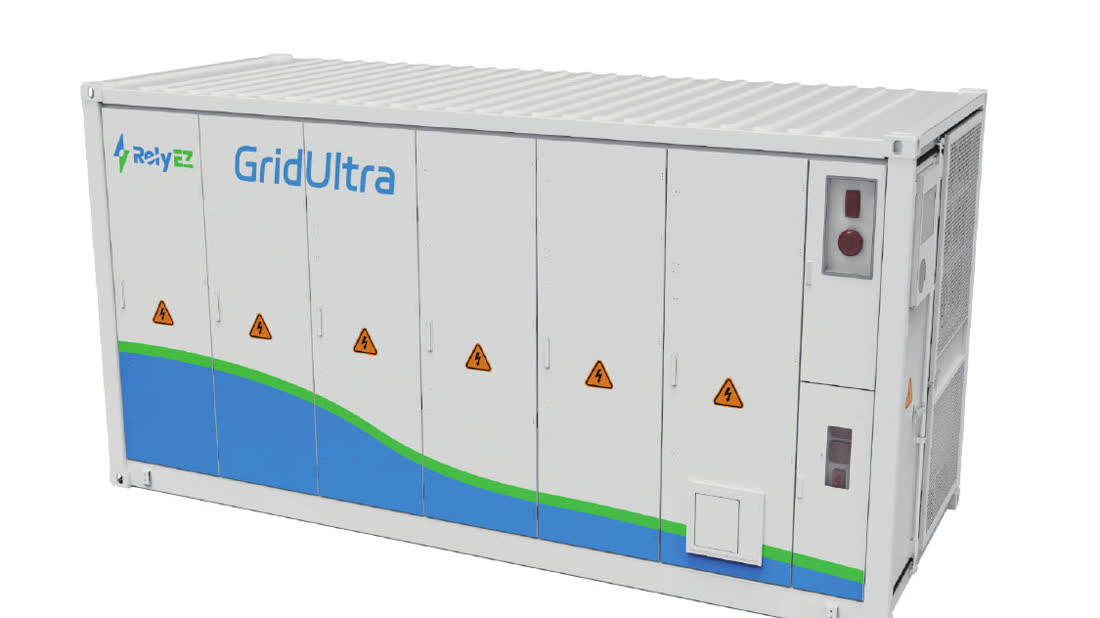
The three models in the range share the same envelope, 6,058 × 2,438 × 2,896 mm. They differ in stored energy, power and cooling.
| Nominal energy | Rated power | Cooling | Stated weight | Stated efficiency | |
|---|---|---|---|---|---|
| GridUltra 2058 | 2,058 kWh | 500 kW (550 kW maximum) | air | 23 t | over 88 % (system) |
| GridUltra 4.18 MWh | 4,180 kWh | 1,045 kW | liquid | 36.5 t | 93 % round trip, beginning of life |
| GridUltra 5.016 MWh | 5,016 kWh | 2,500 kW | liquid | 42 t | 93 % round trip, beginning of life |
The ratio between power and energy gives the discharge time at full power: four hours for the 4.18 MWh (0.25 P rating), two hours for the 5.016 MWh (0.5 P rating). The right model therefore depends on the use. A project that shifts midday solar output to the evening needs energy; a project that sells responsiveness to the grid needs power. The article BESS: the storage system piece by piece explains these notions in detail.
Air or liquid: which cooling to choose?
An LFP cell ages better the more stable and even its temperature stays. Two approaches coexist:
- Air cooling, on the GridUltra 2058: ventilation and air conditioning circulate the air inside the container. It is simpler, and the container is rated IP 54.
- Liquid cooling, on the GridUltra 4.18 and 5.016 MWh: a fluid flows in contact with the modules. The datasheet states a temperature difference between cells of less than 3 °C, and the container is rated IP 55.
The datasheets give the same operating range for both, from -30 °C to 50 °C, up to 2,000 m altitude (above that, with reduced power). They state more than 8,000 cycles and a 15-year design life. Cooling uses electricity: up to 35 kW of auxiliary load for the 4.18 MWh and 45 kW for the 5.016 MWh, to be allowed for in the connection.
How is a storage container installed on a site?
Installation follows a fairly constant order from one project to the next.
1. Size the system and study the grid connection
Everything starts from the need: the site's load curve, solar or hydro output, available connection capacity, services targeted. The method is described in the article Commercial battery storage: how to size it. The grid operator, Enedis or RTE depending on the voltage, then studies the connection request: this is often the step that sets the schedule.
2. Check the administrative framework
Planning rules, classification as an installation classified for environmental protection (ICPE), fire service requirements: the applicable regime depends on the power, the location and the configuration. It is checked project by project, with the town hall, the prefecture and the fire service, before ordering.
3. Prepare the ground
The container rests on a foundation designed for its weight, from 23 to 42 tonnes depending on the model. The location must let the truck and the crane through on installation day, keep the doors accessible for maintenance, and respect the distances set by the safety study. Ducts for power and communication cables are laid at this stage.
4. Set down and connect
The container arrives closed and is set down in one piece. Electricians then connect it to the converter, the transformer substation and the delivery point, and wire the auxiliaries and the communication between the BMS and the converter (CAN, Modbus or TCP according to the datasheet).
5. Commission and operate
Then come the tests, commissioning with the grid operator, and control by an energy management system (EMS) that decides when to charge and discharge. To take part in the electricity markets, this control can be entrusted to an aggregator: see our aggregator page.
How is container safety handled?
It relies on several layers, which the datasheets make it possible to check:
- The chemistry: LFP is the chemistry chosen for its thermal stability.
- Sealing: IP 67 modules, IP 54 or IP 55 container.
- Monitoring: the BMS tracks each module and disconnects in the event of a deviation; the fire protection has its own multi-point detection.
- The design: a container that is not walked into, which keeps people away from live racks.
- The tests: the GridUltra range lists, among others, IEC 62619 (safety of industrial lithium batteries), UL 9540 (storage system), UL 9540A (thermal runaway propagation test) and UN 3536 (transport of batteries installed in a container).
Certificates and test reports are shared within a project, together with the site's safety study.
Container or cabinet: which format for which project?
| Suitable format | Catalogue example | |
|---|---|---|
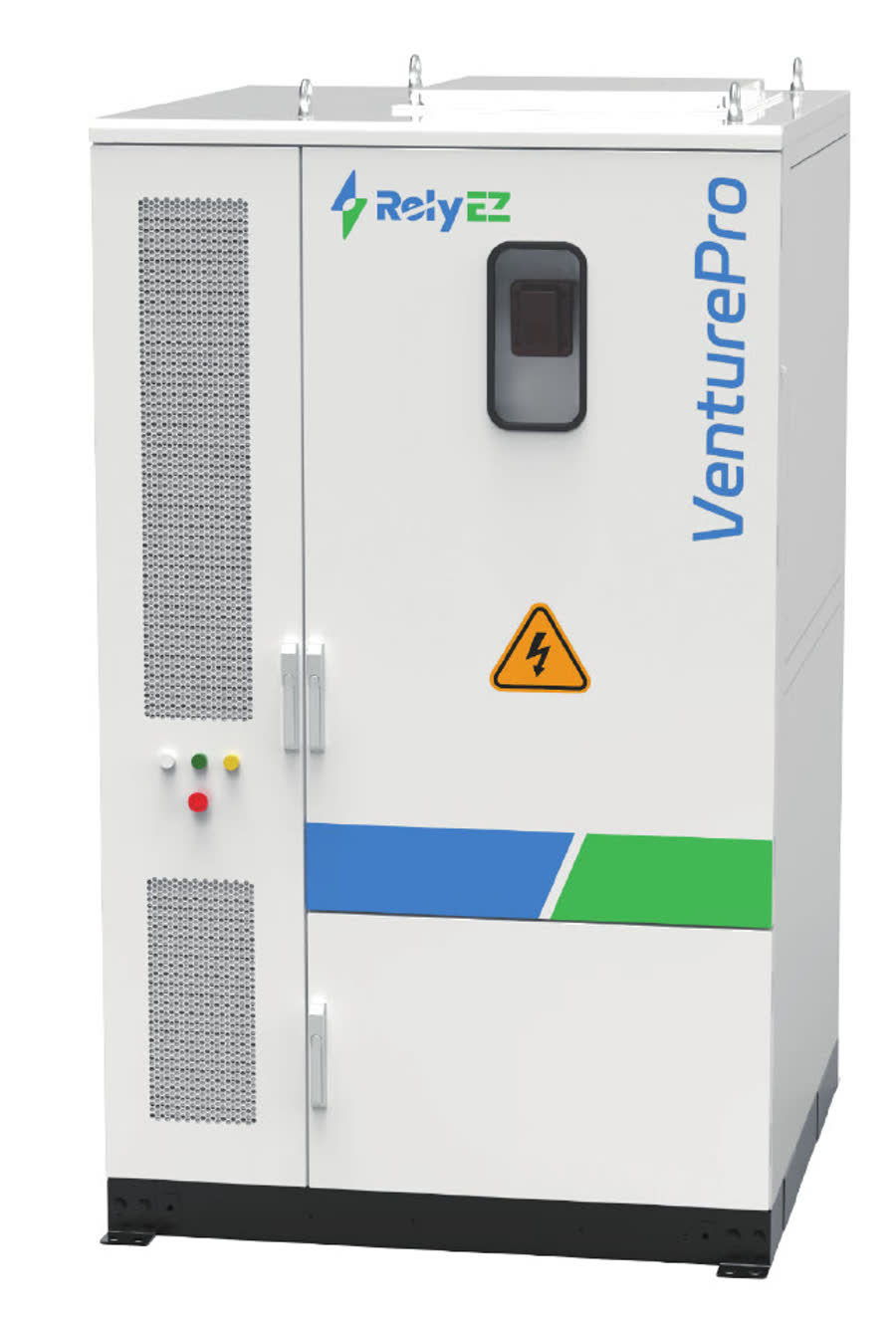
| A few hundred kWh behind the meter | outdoor cabinet | VenturePro 250, 250 kWh / 125 kW |
| From 261 kWh to 3.34 MWh, adding cabinets | cabinets side by side, one control cabinet | Fusion 2 |
| Several MWh, power plant or grid-connected project | 20-foot container | GridUltra, 2,058 to 5,016 kWh |
A cabinet suits most industrial, commercial and agricultural sites, and the Fusion 2 system grows cabinet by cabinet. The container takes over when the energy to store is counted in megawatt-hours: next to a solar plant, a small hydro plant or on a grid-connected plot. RelyEZ's projects in Hungary, for example, total 55 MW / 110 MWh across three sites; they can be seen on our RelyEZ page.
Key points
A battery storage container is standardised equipment, assembled at the factory, that only needs a foundation, setting down and a connection on site. The choice between models comes down to three criteria: the energy to store, the power to deliver and the cooling. The rest, grid connection, administrative framework and safety, is handled project by project, from the study stage.
Frequently asked questions
How much energy does a battery container hold?
It depends on the model. In the RelyEZ GridUltra range, a 20-foot container holds 2,058 kWh in the air-cooled version, and 4,180 kWh or 5,016 kWh in the liquid-cooled versions. As many containers are then lined up as the grid connection and the project require.
How much does a battery storage container weigh?
RelyEZ datasheets state 23 tonnes for the GridUltra 2058, 36.5 tonnes for the 4.18 MWh and 42 tonnes for the 5.016 MWh, all in the same 6,058 × 2,438 × 2,896 mm envelope. This weight determines the foundation, truck access and the lifting equipment on installation day.
Does the container include the inverter?
Not always. The GridUltra 2058 integrates a converter with a transformer and delivers 400 V AC. The GridUltra 4.18 and 5.016 MWh are DC battery containers (1,331.2 V nominal): the converter and the transformer substation are installed alongside and sized with them.
Do you need to enter the container for maintenance?
No. GridUltra containers are designed not to be walked into: the racks are reached through doors on the outside. Remote monitoring tracks the temperature, voltage and condition of each module, which keeps on-site visits to a minimum.
Container or cabinet: which suits a business site?
A cabinet suits needs of a few hundred kilowatt-hours behind the meter, for example a 250 kWh VenturePro 250. The container takes over from a few megawatt-hours, for a renewable plant or a grid-connected project. The choice always starts from the site's load curve and connection capacity.
Sources
The figures in this article come from these documents.
- Fiche technique gamme GridUltra 4,18 MWh (0.25P) et 5,016 MWh (0.5P) — stockage conteneurisé à refroidissement liquide — RelyEZ, 27 August 2026
- Fiche technique GridUltra 2058 Air-Cooled Energy Storage System (YXFJ-500K/18256314-L), reprise sur la page de la gamme — RelyEZ, 27 August 2026
- Fiche technique VenturePro Series 250 kWh — All-in-one Liquid-Cooled Energy Storage — RelyEZ, 27 August 2026
- Panorama de l'électricité renouvelable au 31 décembre 2025 (communiqué de presse) — SER, RTE, Enedis et Agence ORE, 16 July 2026
- Délibération n° 2022-105 du 7 avril 2022 portant avis sur le projet de décret fixant les modalités de la procédure d'appel d'offres portant sur le développement de capacités de stockage d'électricité (rappel de l'article L. 352-1 du code de l'énergie) — Commission de régulation de l'énergie, 7 April 2022
The ranges mentioned
A project in mind?
The grid connection, the contract and the generation already in place are enough to know which range fits.