Technology · 7 October 2026
Electricity storage: the technologies compared
Electricity storage means converting electricity into another form of energy (water at altitude, chemical energy, gas, heat) and giving it back later. Three technologies lead the field: pumped-storage hydro (STEP) at grid scale, batteries for a few hours on a site or at a power plant, and hydrogen for long durations, at the cost of low efficiency. For a business site, the choice starts with the duration to cover.
By Élien Geneste
Electricity storage makes it possible to produce at one time and consume at another: keep the midday solar surplus for the evening, ride through a consumption peak without exceeding the contracted capacity, or help the grid stay balanced. Several technologies do this, at very different scales, durations and efficiencies. This article compares them, to work out which one fits a business site.
What does "storing electricity" mean?
The French Energy Code defines storage in Article L. 352-1, as recalled by the Energy Regulatory Commission (CRE) in its deliberation of 7 April 2022: it is « the deferral of the final use of electricity to a moment later than the one at which it was produced ».
In practice, electricity is very hard to store as it is. It is therefore converted into another form of energy, which is turned back into electricity when needed. Each conversion costs some energy: this is what efficiency measures, the ratio between the electricity returned and the electricity absorbed.
The technologies fall into four families:
- mechanical: pumped-storage hydro (STEP), compressed air, flywheels;
- electrochemical: batteries (lithium, sodium, flow batteries);
- chemical: hydrogen produced by electrolysis;
- thermal: heat stored in molten salts, water or solid materials.
Which electricity storage technologies should be compared?
| Form of stored energy | Target storage duration | Where it is found | |
|---|---|---|---|
| Pumped storage (STEP) | water pumped into an upper reservoir | hours to days | transmission grid, mountain sites |
| Lithium battery (LFP) | chemical energy | minutes to a few hours | business sites, solar plants, grid |
| Hydrogen | gas produced by electrolysis | days to seasons | industrial and transport projects |
| Compressed air | pressurised air in a cavern | hours | a handful of sites worldwide |
| Flywheel | rotational energy | seconds to minutes | stabilisation, uninterruptible power |
| Supercapacitor | electric field | seconds | very short peaks, transport |
| Thermal storage | heat | hours to days | heat networks, industrial processes |
The criterion that settles things fastest is the duration to cover. A technology designed to store a few seconds is no use for shifting solar production, and a seasonal storage technology loses too much energy for daily use.
How does pumped storage work, and why does it lead in France?
A pumped-storage plant links two reservoirs at different heights. When the grid has a surplus, water is pumped from the lower reservoir to the upper one; when power is needed, it flows back down through turbines. It is the oldest large-scale storage method.
According to EDF (page updated on 25 August 2026):
- the French fleet has 6 pumped-storage plants, with an installed capacity of 5 GW;
- Grand'Maison, in Isère, reaches 1,800 MW in three minutes;
- Montézic reaches its maximum output of 920 MW in under two minutes.
These plants require relief, two reservoirs and years of works. They serve the transmission grid, not an industrial site. Their strength is balancing the national power system.
Why are batteries growing so fast?
Because they can be installed almost anywhere, quickly and at any size: a cabinet in a factory yard, a few containers next to a solar plant, dozens of containers connected to the grid. The renewable electricity overview published on 16 July 2026 by SER, RTE, Enedis and Agence ORE counts 1,617 MW of battery storage connected in France at the end of 2025, including 410 MW commissioned in 2025, with 195 MW in the third quarter and 154 MW in the fourth.
Which chemistry for stationary storage?
The chemistry most used for stationary storage is lithium iron phosphate (LFP), chosen for its thermal stability and cycle life. It is the one used in every RelyEZ range, with 314 Ah prismatic cells (see the RelyEZ technology page). Other chemistries exist:
- lithium NMC (nickel-manganese-cobalt), denser, mainly used in electric vehicles;
- sodium-ion, which does without lithium;
- flow batteries (known as "redox flow"), where energy is stored in liquid electrolytes held in tanks.
What the datasheets say
A battery is judged on a few quantities, all stated on the datasheet of the exact model:
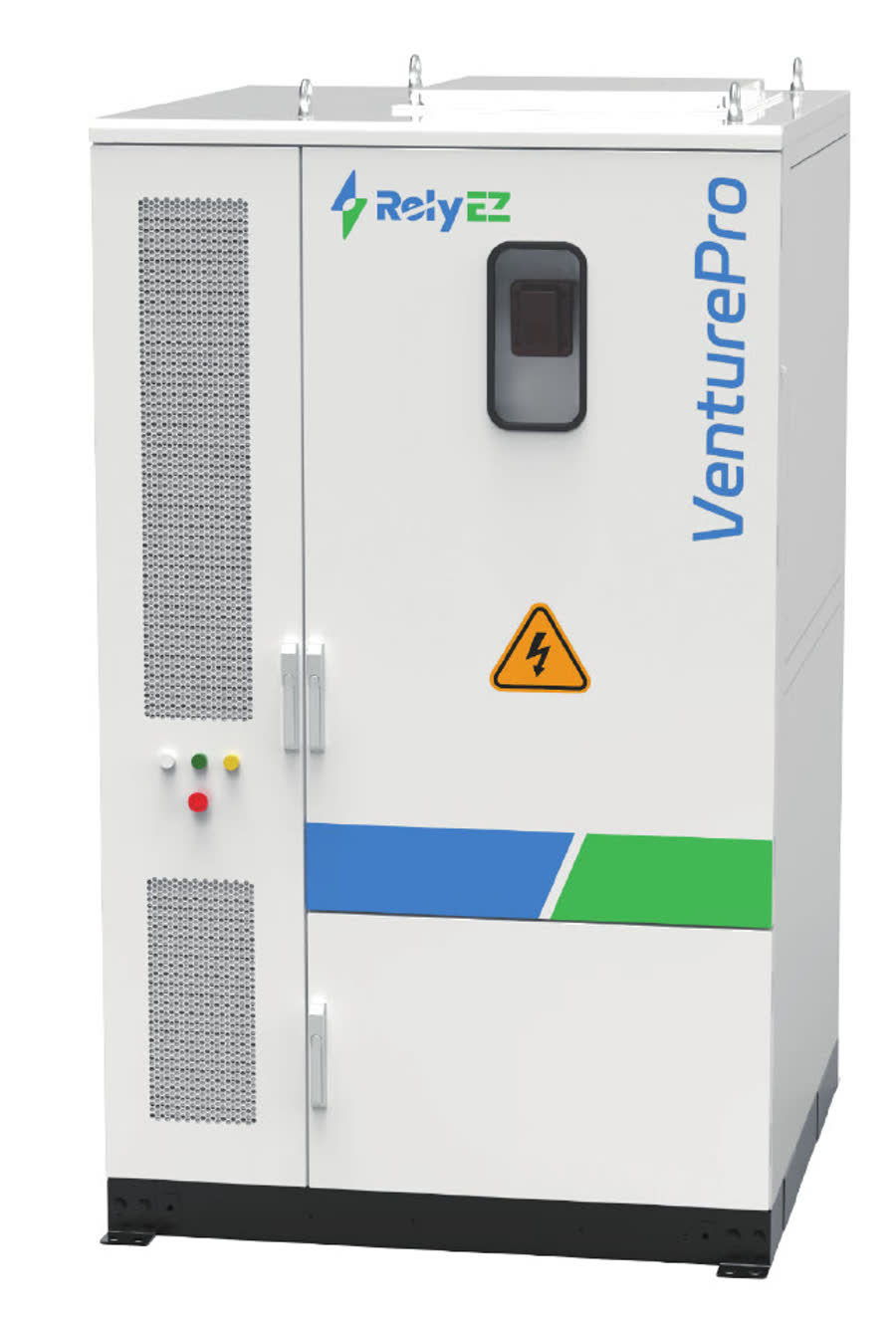
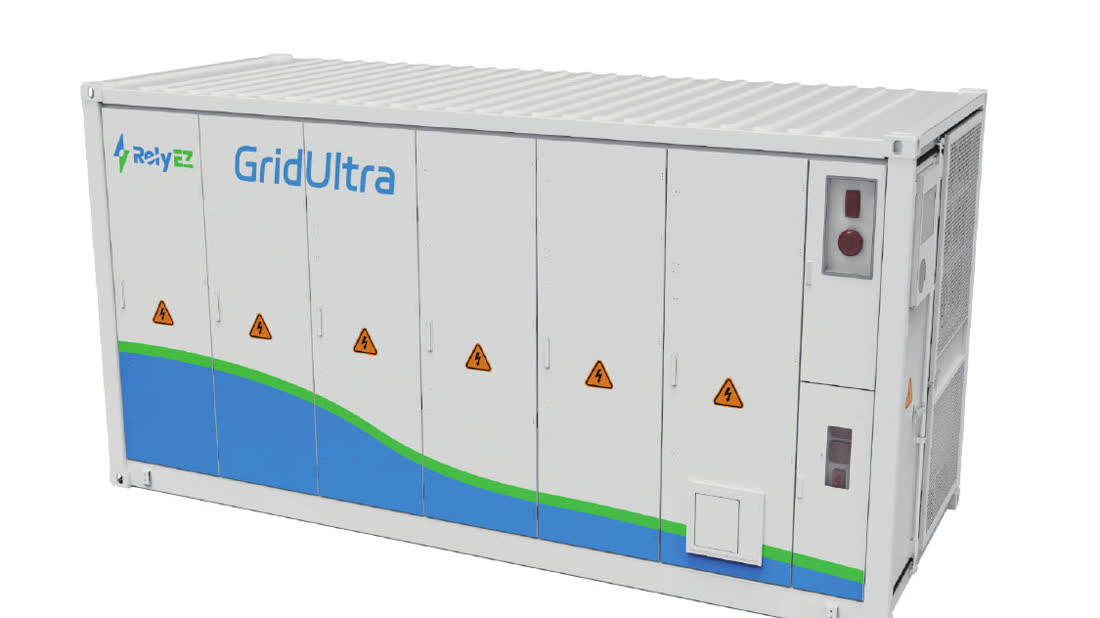
| VenturePro 250 | GridUltra 4.18 MWh | |
|---|---|---|
| Energy | 250 kWh | 4,179.9 kWh |
| Power | 125 kW (built-in inverter) | 0.25 P rate |
| Discharge time at full power | two hours | four hours |
| Stated life | at least 8,000 cycles | more than 8,000 cycles, 15-year design life |
| Format | all-in-one cabinet | container |
The VenturePro 250 datasheet states a maximum AC efficiency of 90%, excluding auxiliaries: out of 100 kWh drawn from the grid, at most 90 kWh come back out, before the consumption of cooling and control. These figures are in the catalogue, range by range.
The ratio between energy and power determines the use. Two hours suit peak shaving on a site; four hours or more, shifting most of a solar plant's output to the evening, as explained in our article on negative prices and solar power.
Can hydrogen store electricity?
Yes, but at a high energy cost. An electrolyser splits water to produce hydrogen; the gas is compressed and stored, then turned back into electricity in a fuel cell. ADEME, the French environment and energy agency, studied this "Power-to-H2-to-Power" chain: its overall efficiency, from the electrical source to the end use, is in the order of 25%, or even 30% with the best equipment. The agency recommends favouring electrochemical storage where it is technically and economically feasible.
Hydrogen's value lies elsewhere: it can be stored for several days, weeks or months, and used directly as a feedstock or fuel, in industry or transport. It is a long-duration storage tool, not a substitute for a battery in daily use.
What about compressed air, flywheels and heat?
These technologies meet specific needs:
- compressed air stores energy by compressing air in an underground cavern; it requires suitable geology;
- flywheels store energy in a rotor spinning very fast, for a few seconds to a few minutes: they are used to stabilise voltage or ensure continuity of supply;
- supercapacitors absorb and deliver very high power for a few seconds;
- thermal storage keeps heat, rather than electricity, for a process or a heat network.
None of them replaces a battery for storing a few hours of electricity on a site, but they complete the storage landscape.
Which storage technology for a business site?
For a company, a local authority, a farm or a solar plant, the question is rarely pumped storage versus battery: the battery is what gets installed behind the meter. The real question is which one, and what size. It is settled with a few pieces of data:
- The intended use: shaving peaks, keeping the solar surplus, powering a fast-charging station, taking part in flexibility markets through an aggregator.
- The duration to cover: it sets the ratio between energy and power.
- The site's load curve, and its solar production if any.
- The grid connection capacity and the space available: cabinet or container.
Our article on storage batteries for businesses details this sizing method step by step. For a business site, the VenturePro range covers all-in-one cabinets; for a power plant or a high-power site, GridUltra containers are added according to the grid connection.
Where to start?
The right storage is chosen from the site: what it consumes, what it produces, what its grid connection allows. That is the starting point of our project assessment, which leads to a detailed configuration and a justified sizing. The datasheets for each range are in the catalogue.
Frequently asked questions
Can electricity be stored directly?
Almost never in large quantities: it is converted into another form of energy, then converted back when needed. A pumped-storage plant stores it as water at altitude, a battery in chemical form, hydrogen as a gas. Only supercapacitors and superconducting coils keep energy in electrical form, for very short periods.
Which storage technology is the most widely used in France?
In installed capacity, pumped storage: EDF operates six pumped-storage plants (STEP) totalling 5 GW. Batteries are growing fast: 1,617 MW were connected at the end of 2025, including 410 MW commissioned during the year, according to the renewable electricity overview published by SER, RTE, Enedis and Agence ORE.
Which storage technology suits a business?
To store a few hours of electricity on an industrial, commercial or agricultural site, the lithium iron phosphate (LFP) battery is the solution installed behind the meter, in a cabinet or a container. Sizing starts from the load curve, any solar production and the grid connection capacity. Pumped storage or a hydrogen chain belong to other scales and other uses.
Why isn't hydrogen used to store a site's electricity?
Because the electricity-hydrogen-electricity chain loses a large share of the energy: ADEME puts its overall efficiency in the order of 25%, or even 30% with the best equipment. Hydrogen makes most sense when energy must be stored over several days or months, or when the gas itself is used, for instance in industry or transport.
How long does a storage battery deliver its energy for?
It depends on the ratio between its energy and its power. A RelyEZ VenturePro 250 cabinet (250 kWh, 125 kW) discharges in two hours at full power; a GridUltra 4.18 MWh container, at a 0.25 P rate, in four hours. The ratio is chosen according to the use: shaving a peak or shifting solar production.
Sources
The figures in this article come from these documents.
- Panorama de l'électricité renouvelable au 31 décembre 2025 (communiqué de presse : « Les énergies renouvelables ont couvert 33,2 % de la consommation d'électricité de la France en 2025 ») — SER, RTE, Enedis et Agence ORE, 16 July 2026
- Les stations de transfert d'énergie par pompage — EDF, 25 August 2026
- Rendement de la chaîne hydrogène : cas du « Power-to-H2-to-Power » (fiche technique ADEME, présentée par Connaissance des Énergies) — ADEME, 13 February 2020
- Délibération n° 2022-105 du 7 avril 2022 portant avis sur le projet de décret fixant les modalités de la procédure d'appel d'offres portant sur le développement de capacités de stockage d'électricité (rappel de l'article L. 352-1 du code de l'énergie) — Commission de régulation de l'énergie, 7 April 2022
- Fiche technique VenturePro Series 250 kWh — All-in-one Liquid-Cooled Energy Storage — RelyEZ, 27 August 2026
- Fiche technique gamme GridUltra 4,18 MWh (0.25P) et 5,016 MWh (0.5P) — stockage conteneurisé à refroidissement liquide — RelyEZ, 27 August 2026
The ranges mentioned
A project in mind?
The grid connection, the contract and the generation already in place are enough to know which range fits.