
Grid connection · Sizing · 16 October 2026
Rapid charging: opening a station without reinforcing the grid connection
The grid connection of a rapid charging station is usually sized on the sum of its chargers: two 150 kW chargers already exceed the 250 kVA limit of low voltage. A buffer battery changes the equation. The grid recharges it continuously over a modest connection, and it supplies the extra power during charging sessions. It is sized on the station's traffic, not on the chargers' nameplate.
By Élien Geneste
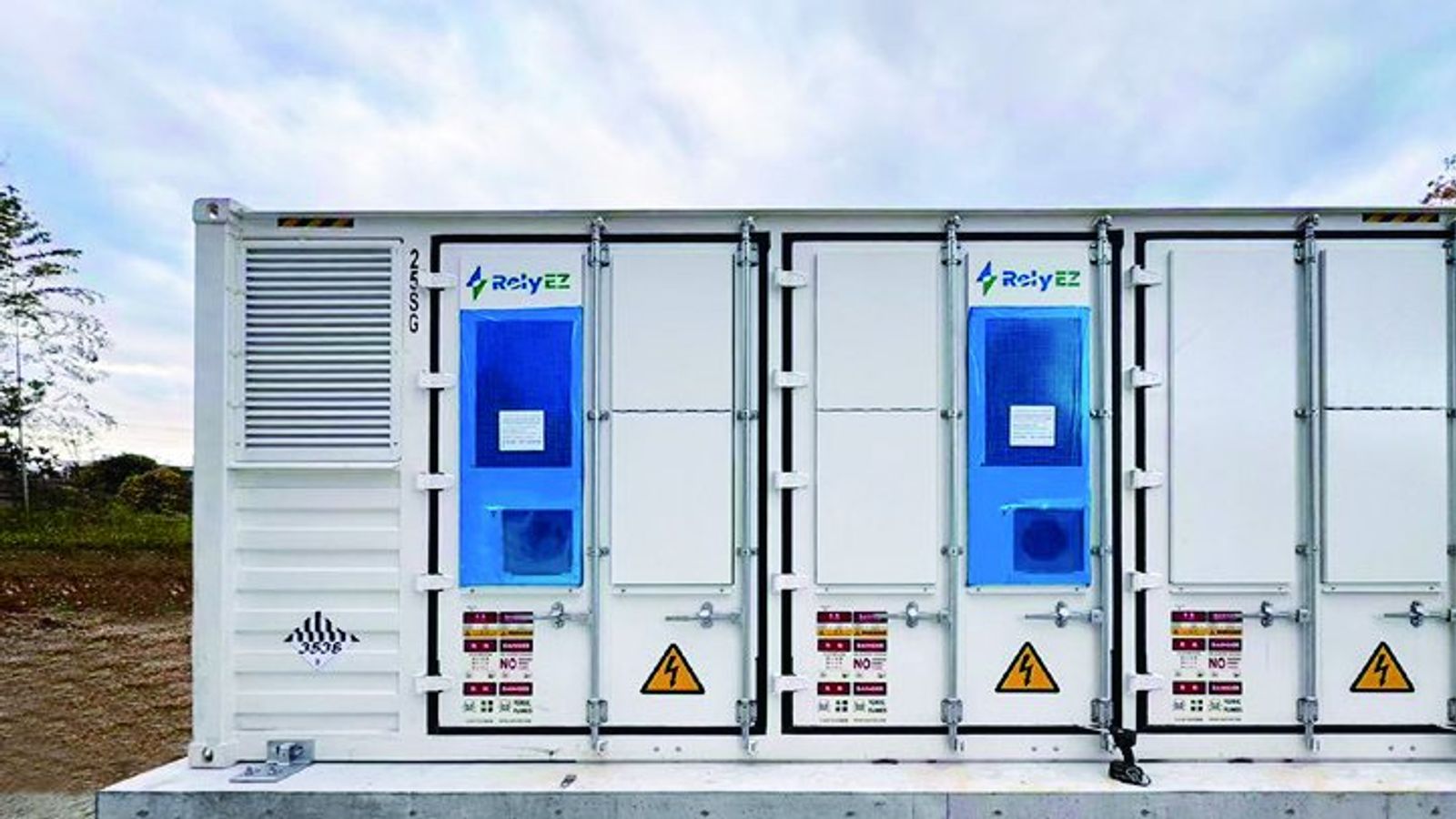
Opening a rapid charging station rarely runs into trouble with the chargers: it runs into trouble with the grid connection. The power requested from the network follows the sum of the chargers, and it quickly moves the site into a different category, with studies, works and lead times. This article explains why, what a buffer battery changes, and how to size it on the station's real traffic.
Why does the grid connection hold back the opening of a station?
A rapid charger draws the power of a small industrial site. On 31 July 2026, France had 200,045 public charging points, of which 13 % were above 150 kW and just over 5,000 were rated at 350 kW or more (Avere-France barometer, reported by Automobile Propre on 10 August 2026). This is the growing segment, and it is the one that weighs on the grid.
The grid operator connects a site according to the power requested. In low voltage, Enedis's offer templates cover installations from 36 to 250 kVA; above that, the request follows the HTA (medium voltage) procedure (Enedis note of 15 September 2025). Two 150 kW chargers used at the same time already call for 300 kW: the station leaves low voltage before it has even opened its third bay.
This change of category costs above all in time. For motorway stations, Enedis and RTE indicated in July 2021 lead times of 12 to 24 months to carry out studies, obtain permits and complete grid adaptation works. Their conclusion was positive: the grid can accommodate these stations, provided project developers anticipate their requests. The same study estimated needs at 4 to 12 MW on average per motorway service area in 2035.
What has changed in the cost of connection
For several years, the network tariff covered up to 75 % of the connection cost of certain public chargers:
- those included in a local authority's master plan, for a connection of 250 kVA or less, if the complete request was received before 31 December 2025 (order of 6 February 2023);
- those on motorway and expressway service areas, for requests sent before 31 December 2025 (law of 22 August 2021, article 118).
For a request filed today, the standard rate applies. Every kVA of connection avoided is therefore worth more than before.
How does a buffer battery make it possible to keep a small connection?
The principle works in two stages:
- Between sessions, the grid recharges the battery continuously, at the power allowed by the existing connection or by a modest one.
- During sessions, the chargers draw on both the grid and the battery. The battery supplies the gap between the power demanded by the vehicles and the power available at the meter.
The connection is no longer sized on the peak, but on the energy to be put back into the battery between two waves of sessions. A station that sees short, spaced-out peaks, like most stations away from the main routes, is well suited to this.
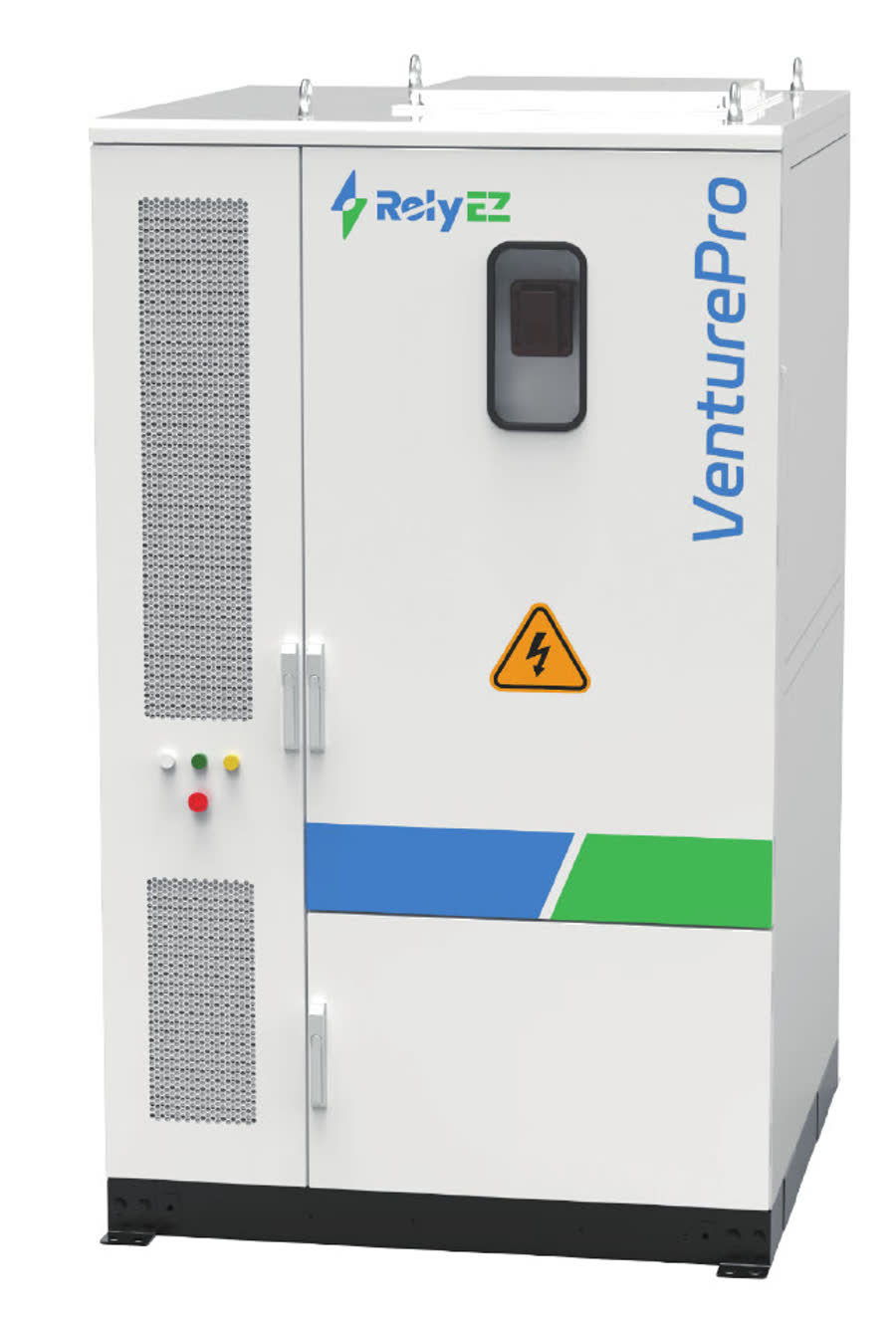
The control system does the rest. The battery management system reads the power drawn at the delivery point and adjusts the discharge so that the site never exceeds its subscribed power. On the VenturePro 250 cabinet, switching from charge to discharge takes less than 20 ms (RelyEZ datasheet).
An example to set the orders of magnitude
Take a station with two 150 kW chargers, on a site with 120 kW available at the meter. The figures below are an illustrative calculation, not a measurement.
| Power | Duration | Energy | |
|---|---|---|---|
| Two vehicles charge at full power | 300 kW | 30 min | 150 kWh |
| Share supplied by the grid | 120 kW | 30 min | 60 kWh |
| Share supplied by the battery | 180 kW | 30 min | 90 kWh |
| Battery recharged by the grid | 120 kW | 45 min | 90 kWh |
Here you need a battery able to deliver 180 kW and store at least 90 kWh of usable energy, with a margin. Two VenturePro 250 cabinets in parallel (250 kW and 500 kWh in total) cover this case with a reserve for a second wave of sessions. In practice, a vehicle does not charge at full power for the whole session: its power falls as its battery fills, which lightens the need.
How do you size a charging station's battery?
The method starts from the traffic, not from the catalogue.
- The expected session profile. Number of vehicles per hour, average charging time, simultaneity at busy times. For an existing station, the charger logs provide it; for a new station, you start from the site's traffic and from prudent assumptions.
- The available power. What the current connection leaves free once the site's other uses are deducted, or what a low-voltage connection would allow. The site's consumption data, available from Enedis, show the real margin hour by hour.
- The battery's power. It is set by the gap between the chargers' peak and the available power.
- The battery's energy. It is set by the worst sequence of the day: the longest run of sessions during which the battery empties faster than the grid refills it. A margin is added for depth of discharge and ageing.
- The recharge time. You need to check that the battery has time to fill up before the next wave. If not, you increase the energy or the connection power, or combine the two.
- The site. Location, access, temperature: the VenturePro 250 operates from −30 to 55 °C, at reduced power outside the −15 / 45 °C range, and has a footprint of 1,350 × 1,400 mm (RelyEZ datasheet).
The same reasoning applies to a site adding chargers to an existing consumption: the battery then also avoids exceeding the subscribed power.
Which batteries for which station?
The catalogue's two cabinets connect at 400 V AC, on the site's grid side, and are added without touching the chargers.
| VenturePro 250 | VenturePro Fusion | |
|---|---|---|
| Format | all-in-one cabinet, built-in inverter | control cabinet and battery cabinets |
| One cabinet | 250 kWh, 125 kW | 261 to 418 kWh, 130.6 to 208.9 kW depending on the reference |
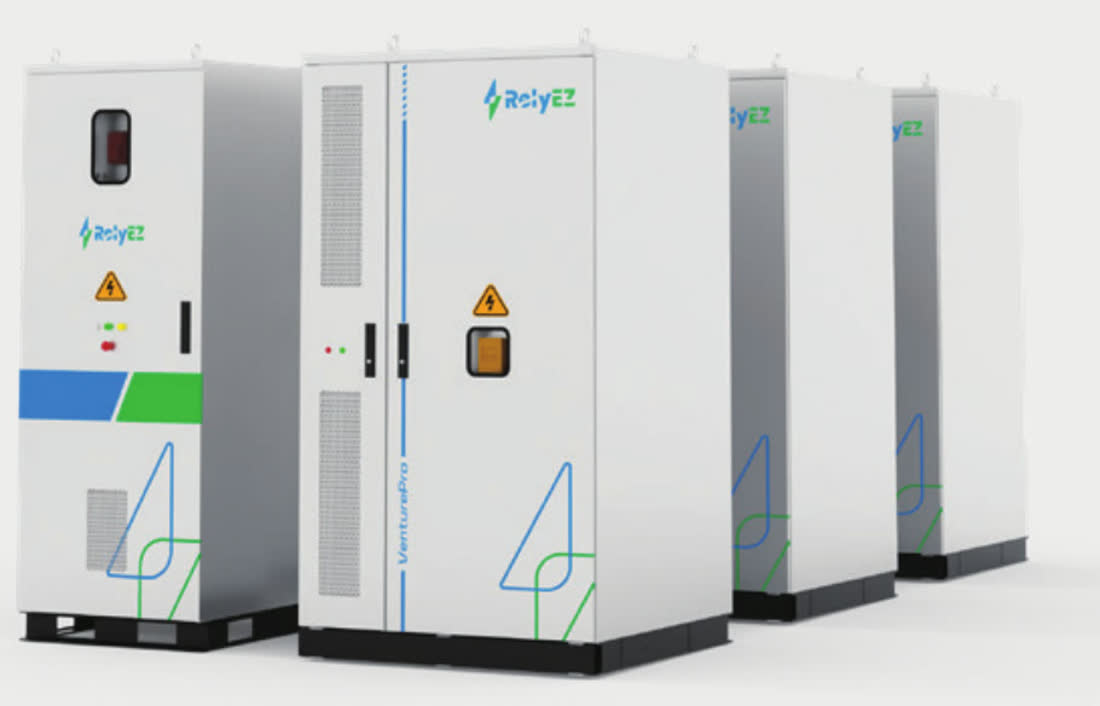
| Extension | up to 12 cabinets in parallel | one control cabinet for one to eight battery cabinets |
| For which station | two to four chargers, step-by-step extension | busier station, higher energy need |
Sources: RelyEZ datasheets VenturePro Series 250 kWh and VenturePro Fusion.
The VenturePro Fusion range suits a station that has to handle several waves of sessions in a row without leaving the battery much time to recharge. The VenturePro 250 cabinet follows a growing station: you add a cabinet when you add chargers.
Which obligations are driving the equipment of major routes?
The European AFIR regulation sets a grid of charging pools on the trans-European transport network. On the core network, it requires a charging pool of at least 400 kW every 60 km by the end of 2025, then of at least 600 kW by the end of 2027, with points of at least 150 kW. These powers add up on a single site: this is exactly the situation where a buffer battery avoids sizing the connection on the chargers' nameplate.
What the battery does not replace
- The connection request. The station remains connected to the public grid: the battery reduces the power to request, it does not remove the procedure. It is best filed early, with a power that takes the storage into account.
- Export. A battery that only draws power stays within the framework of a consumption connection. If it is ever to export, for example to sell its flexibility, Enedis treats it as an installation "able to export and draw power", with its own offer templates (Enedis note of 15 September 2025). It is worth planning for this from the study stage: a station's battery can also earn revenue on the electricity markets.
- The chargers and their installer. The battery is added to the charging installation; it is installed with it. JR Énergie, the group's installer, holds the Qualifelec IRVE qualification and installs solar carports and chargers: the solar car park with storage and charging can be designed as a single project.
The rapid charging page presents the group's offer, and the assessment starts from three elements: the existing connection, the power of the planned chargers and the expected traffic.
Frequently asked questions
What grid connection capacity does a rapid charging station need?
Without storage, the connection is generally sized on the power of the chargers used at the same time: two 150 kW chargers already call for 300 kW, beyond the 250 kVA limit of low voltage. With a buffer battery, it is sized on the energy consumed on average over the day and on the time left for the battery to recharge. The gap between the two is what the battery supplies.
Can a battery keep a station on a low-voltage connection?
Often, yes, if the traffic allows it. In low voltage, Enedis connects up to 250 kVA; the battery covers the part of the peak above the available power, then recharges between two waves of sessions. This has to be checked against the expected traffic profile: a station that is busy all day leaves the battery little time to recharge.
How long does it take to connect a high-power charging station?
Enedis and RTE indicate lead times of 12 to 24 months for studies, permits and grid adaptation works, depending on the power and configuration. The chargers themselves are installed much faster. A more modest connection, complemented by a battery, reduces the scale of the works required.
Is the connection of a public charger still 75 % covered by the network tariff?
No. The 75 % coverage by the network tariff applied to connection requests received before 31 December 2025, for public chargers included in a local master plan (up to 250 kVA) and for those on motorway and expressway service areas. For a request filed today, the standard rate applies: every kVA avoided counts for more.
Can a charging station's battery be used for anything else?
Yes. Between two waves of sessions, the same battery can store the surplus from a solar carport or recharge during off-peak hours. If it is ever to export to the grid, Enedis treats the installation as one able to both export and draw power, with its own connection procedure.
Sources
The figures in this article come from these documents.
- Mobilité électrique et développement des bornes de recharge rapide sur autoroute : les réseaux électriques (Enedis et RTE) sont prêts — Enedis et RTE, 20 July 2021
- Avenant L342-6 à la proposition technique et financière pour le raccordement d'une installation de production ou susceptible d'injecter et de soutirer de puissance comprise entre 36 et 250 kVA au réseau public de distribution BT (Enedis-MOP-RES_049E) — Enedis, 15 September 2025
- Arrêté du 6 février 2023 relatif à la prise en charge par le tarif d'utilisation des réseaux publics d'électricité du raccordement des infrastructures de recharge ouvertes au public qui s'inscrivent dans un schéma directeur — Légifrance, 6 February 2023
- Loi n° 2021-1104 du 22 août 2021 portant lutte contre le dérèglement climatique et renforcement de la résilience face à ses effets, article 118 — Légifrance, 22 August 2021
- Règlement (UE) 2023/1804 du 13 septembre 2023 sur le déploiement d'une infrastructure pour carburants alternatifs (AFIR) — EUR-Lex, Union européenne, 13 September 2023
- C'est fait : la France passe le cap des 200 000 points de recharge ouverts au public (baromètre Avere-France au 31 juillet 2026) — Automobile Propre, 10 August 2026
- Fiche technique VenturePro Series 250 kWh — All-in-one Liquid-Cooled Energy Storage — RelyEZ, 27 August 2026
- Fiche technique VenturePro Fusion — Liquid-Cooled Modular Battery Cabinet System — RelyEZ, 27 August 2026
The ranges mentioned
A project in mind?
The grid connection, the contract and the generation already in place are enough to know which range fits.