
Revenue and markets · Regulation · Sizing · 3 November 2026
Micro-hydro plants and batteries in France: shifting output within the contract rules
A run-of-river micro-hydro plant generates when the water flows, not when prices rise: a battery shifts that output by a few hours without touching the turbined flow. Under a French H16 contract this is possible on one condition, that the stored energy comes exclusively from the plant. Sizing starts from actual generation during the hours to be shifted, and the decision is taken with the contract in hand.
By Élien Geneste
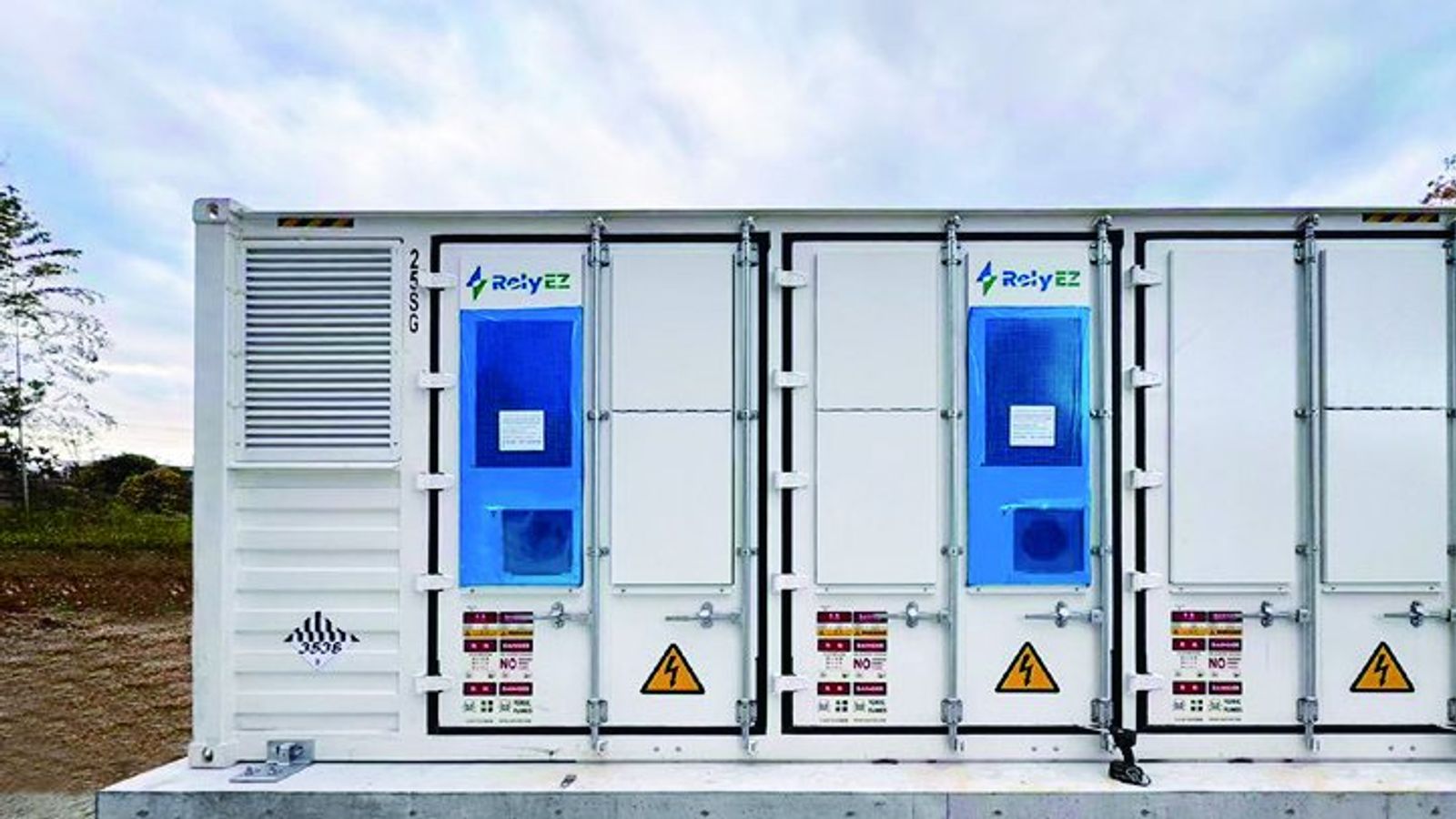
Pairing a micro-hydro plant with a battery gives continuous generation something it lacks: a choice of when to inject. The question is a practical one for owners of small plants in France, whose contract has just changed again. Here is what the text says, what the battery really changes and how to size it.
Why put a battery on a run-of-river micro-hydro plant?
A run-of-river plant turbines the available flow at all hours. It has no reservoir in which to wait for a better moment: water passing through is either generated or lost to the plant. This regularity is its strength, and it gives the French fleet a solid position: 25,747 MW installed at the end of 2025 and 56.7 TWh of renewable generation in 2025, or 12.7% of mainland consumption, according to the Panorama of renewable electricity.
Market prices, however, are no longer regular. RTE counted 513 hours of negative prices in 2025. The solar side of this topic is covered in our article on negative prices and solar PV. For hydro, one point reads differently: the French energy regulator (CRE) estimates that small plants under feed-in contracts ran at an average of 44% of their capacity during these episodes in 2024, and 34% in 2025. The plant therefore generates a significant share of its capacity at those hours.
The battery comes in after the turbine. It stores part of the electricity generated and returns it later, without changing the turbined flow or the water regulations.
Which contract applies to a small plant?
The reference framework is the order of 13 December 2016, known as "H16", most recently amended by the order of 28 May 2026, published in the Official Journal of 1 August 2026. In its opinion of 5 March 2026, the CRE summarises the open-window schemes for installations under the authorisation regime:
| Installed capacity | Possible support | |
|---|---|---|
| New | under 200 kW (threshold applicable since 1 January 2026) | Feed-in contract |
| New | under 1 MW | Contract for difference |
| Existing, with an investment programme | under 1 MW | Contract for difference |
Above 1 MW, a new installation goes through a call for tenders. The 200 kW threshold comes from decree no. 2025-498 of 5 June 2025, cited by the CRE: an older contract may have been signed under a different threshold. The first step is therefore to reread your own contract, with the version of the order that applies to it.
Can you store under an H16 contract?
Yes. Article 1 of the order allows storage devices to benefit from a feed-in contract or a contract for difference "only insofar as a technical device makes it possible to guarantee that the stored energy comes exclusively" from the hydroelectric installation.
This has three practical consequences:
- Charging comes from the plant. The electrical layout and the control system must prevent any charging from the grid, and be able to show it.
- Pumped storage is a separate matter. An installation whose pumped storage needs energy to fill benefits from neither a feed-in contract nor a contract for difference. A battery does not fall into this case.
- The counterparty is informed upstream. The change to the layout and its treatment in the contract are checked with the counterparty before ordering equipment.
What is the effect on installed capacity?
This is the least discussed point, and it deserves checking from the pre-project stage. Under Article 3 of the order, installed capacity is the connection capacity, increased where applicable by the maximum active power generated above that connection capacity without being injected, in particular because it is stored.
Two configurations can be distinguished:
- The plant generates within its connection capacity. The battery shifts part of this generation in time. The connection capacity remains the reference.
- The battery is used to generate above the connection capacity. The extra power generated and stored is added to installed capacity.
The second case can cross a threshold in the table above. It is therefore calculated before setting the battery's power, from the maximum power the turbine can actually deliver.
What happens during negative-price hours?
It all depends on the contract. Under a contract for difference, Annex III of the order provides a premium for hours of strictly negative prices with no grid injection. The order of 28 May 2026 changed its two parameters:
| Before the order of 28 May 2026 | Since | |
|---|---|---|
| Hours without a premium at the start of the calendar year | first 70 hours | first 30 hours |
| Premium coefficient | 0.6 | 0.4 |
The formula now reads: premium = 0.4 × connection capacity × reference tariff × number of hours concerned. These changes follow the recommendation of the CRE, which considered a 40% factor consistent with observed load factors. A contract already signed is read according to its own conditions: this should be checked with the counterparty.
The text focuses on the absence of grid injection. A battery absorbing generation during these hours therefore raises the question of how storage and the premium combine: the answer should be confirmed by the counterparty for the contract concerned, before building the control strategy on it.
How should the battery be sized?
The method has four steps and assumes no result in advance.
- Obtain the generation curve, at the finest time step available and over several years if possible. Hydrology varies from year to year: a single year is not enough to describe a plant. In 2020 the CRE noted that 75% of the installations in its panel reported output of 2,000 to 4,300 full-load equivalent hours per year, which gives an order of magnitude to compare with the actual curve.
- Choose the service. Shifting injection, avoiding injection at negative prices, supplying a neighbouring site or taking part in the markets: each calls for its own sizing.
- Measure the energy to shift. This is generation during the target hours, not the turbine's rated power.
- Separate the seasons. High water fills the battery quickly, while low water leaves more flexibility. Sizing based only on peak generation is often little used for the rest of the year.
A worked example
Take, as an illustration, a plant with 150 kW of connection capacity. It generates 40% of its capacity during a five-hour episode, or 60 kW for five hours: 300 kWh to absorb, before conversion losses. This calculation gives an amount of energy to store, not a gain: the value then depends on the contract, prices and the number of cycles.
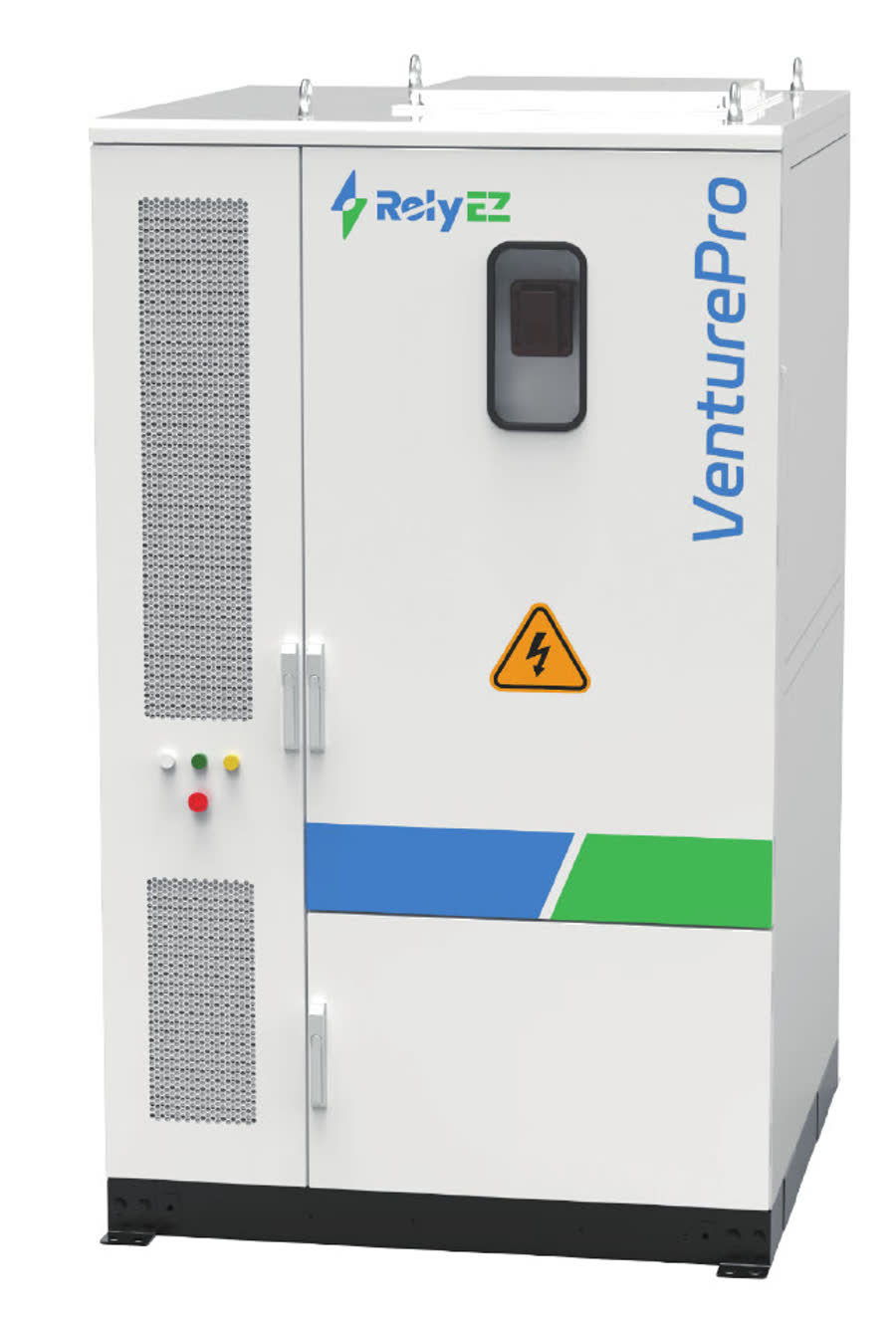
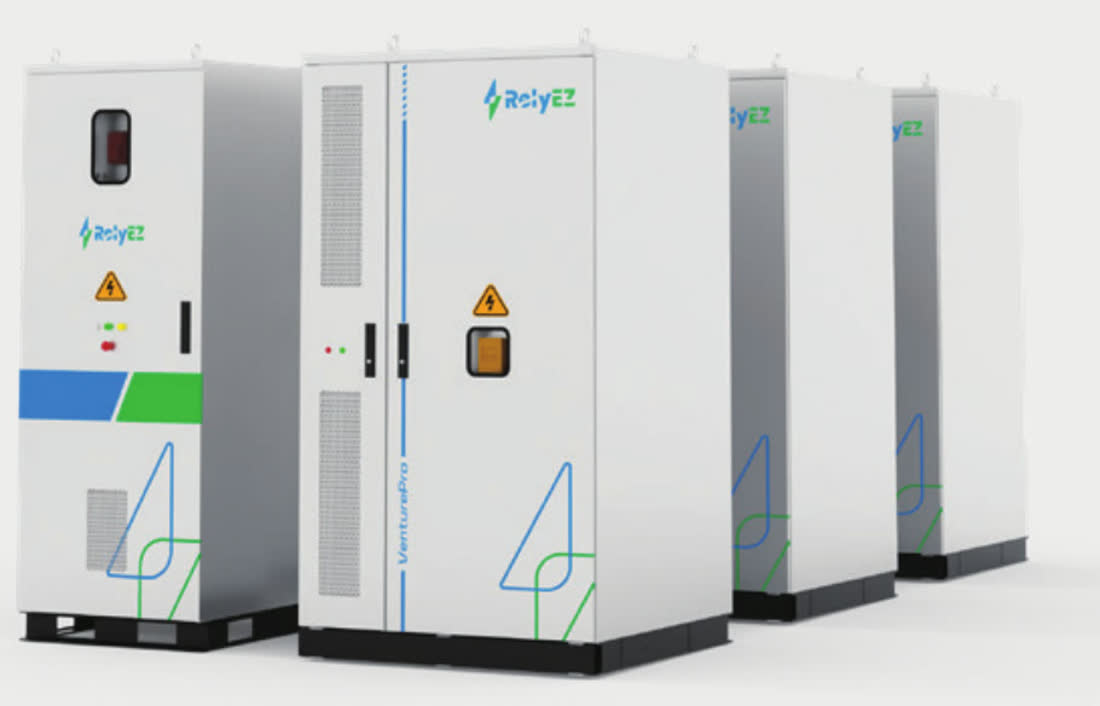
At this scale, a VenturePro 250 cabinet (250 kWh, 125 kW) covers part of the episode, and a Fusion 313 cabinet from the Fusion 2 range (313 kWh, 156.7 kW) the whole episode, excluding losses. The final choice comes from the site study and the actual curve.
Which range for which plant?
| VenturePro 250 | Fusion 2 | |
|---|---|---|
| Energy | 250 kWh per cabinet | from 261 kWh to 3.34 MWh with a single control cabinet |
| Power | 125 kW per cabinet | from 130.6 to 208.9 kW per battery cabinet |
| Inverter (PCS) | built into the cabinet | to be planned, sized and supplied with the project |
| Extension | additional cabinets | 1 to 8 battery cabinets per control cabinet |
The Fusion 2 range is listed in the catalogue for generating plants, hydro included. The choice comes down to the connection point, the space available near the plant and the temperature of the room or platform.
Can the battery provide other services?
Yes, subject to the contract and the project study. A battery can take part in the electricity markets through an aggregator: our article on how a battery is remunerated details the mechanisms. The charging rule in Article 1 must still be respected as long as the battery falls within the plant's contract.
Another use under study is reducing mechanical stress. Tests on a reduced-scale platform, published in 2024, compared a Kaplan turbine paired with a battery and a turbine converted to variable speed to provide frequency reserve, with the aim of limiting mechanism fatigue. They concern machines on a different scale from a micro-hydro plant and do not transfer directly.
Backup or islanded operation is validated project by project: it depends on the electrical layout, the turbine and the protections.
Where to start?
Three documents are enough to open the study: the current contract, the generation curve and the connection diagram. With them, the project assessment sets the target service, checks the contract thresholds and proposes an initial battery size. For the general method, see also our guide to sizing a storage battery.
Frequently asked questions
Can a battery be added to a micro-hydro plant under an H16 contract?
Yes, on one condition set by Article 1 of the order of 13 December 2016: a technical device must guarantee that the stored energy comes exclusively from the hydroelectric installation. The battery therefore charges from the plant, never from the grid. The project should be presented to the contract counterparty before ordering.
Does a battery change the plant's installed capacity?
It can. The order adds to the connection capacity the maximum power generated above it without being injected, in particular when it is stored. A plant that stores in order to generate more than its connection capacity therefore sees its installed capacity rise, which matters for the 200 kW and 1 MW thresholds.
What does the H16 contract provide during negative-price hours?
Under a contract for difference (complément de rémunération), a premium is paid beyond the first 30 hours of strictly negative prices in the year, for hours with no grid injection. Since the order of 28 May 2026 it equals 0.4 × connection capacity × reference tariff × number of hours. Each producer should check the version applying to their own contract.
What size of battery suits a micro-hydro plant?
Start from the generation curve at the finest time step available, then measure the energy generated during the hours to be shifted. Battery power follows the output to absorb and battery energy follows the duration to cover, conversion losses included. Low-water and high-water periods are looked at separately, as they do not call for the same service.
Does a battery replace a plant's water management?
No. Turbined flow, reserved flow and the water regulations come under the plant's authorisation, and the battery does not touch them. It acts after the turbine, on the moment the electricity goes to the grid or is consumed on site.
Sources
The figures in this article come from these documents.
- Arrêté du 13 décembre 2016 fixant les conditions d'achat et du complément de rémunération pour l'électricité produite par les installations utilisant l'énergie hydraulique des lacs, des cours d'eau et des eaux captées gravitairement (version consolidée) — AIDA, Ineris, 30 October 2026
- Arrêté du 28 mai 2026 modifiant l'arrêté du 13 décembre 2016 (JO n° 178 du 1er août 2026) — AIDA, Ineris, 1 August 2026
- Délibération n° 2026-58 du 5 mars 2026 portant avis sur un projet d'arrêté modifiant l'arrêté du 13 décembre 2016 — Commission de régulation de l'énergie, 5 March 2026
- Panorama de l'électricité renouvelable au 31 décembre 2025 (communiqué de presse) — SER, RTE, Enedis et Agence ORE, 16 July 2026
- Bilan électrique 2025 — principaux résultats — RTE, 1 February 2026
- Repurposing Kaplan turbines as variable-speed propellers, compared with a Kaplan turbine hybridised with a battery (arXiv 2405.03201) — arXiv, 6 May 2024
- Fiche technique VenturePro Fusion — Liquid-Cooled Modular Battery Cabinet System — RelyEZ, 27 August 2026
- Fiche technique VenturePro Series 250 kWh — RelyEZ, 27 August 2026
The ranges mentioned
A project in mind?
The grid connection, the contract and the generation already in place are enough to know which range fits.